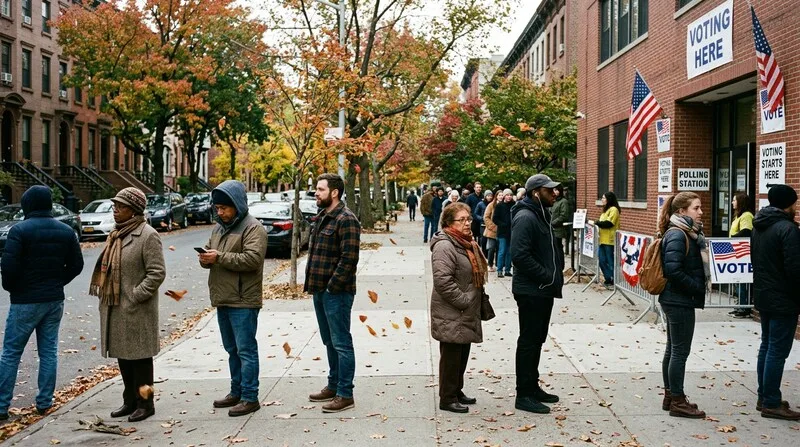
- Indivisible's 800+ chapters across all 50 states represent the organized infrastructure layer of Democratic base enthusiasm — founded December 2016 using the Tea Party's own playbook of constituent pressure on local members of Congress, regardless of whether those members are persuadable
- ActBlue vs. WinRed at 2:1 in Q1 2026 matches the small-dollar fundraising dynamic of 2017-2018 — one of the strongest observable leading indicators of Democratic grassroots motivation ahead of a midterm wave
- DCCC has 500+ field staff deployed to 30 target districts — the same districts where the House majority will be decided; field investment of this scale in April is unusually early and reflects confidence in the environment
- 200+ Republican members have faced disrupted or avoided town halls; the earned media from constituent confrontations is a deliberate component of the organizing strategy — a direct replication of the Tea Party tactic that proved its value against Democrats in 2010
Indivisible: The Tea Party Model in Reverse
Indivisible was founded in December 2016 by former congressional staffers who wrote a guide analyzing why the Tea Party was effective at blocking Obama's agenda: consistent constituent pressure on local members of Congress, regardless of whether those members were persuadable. The guide went viral and spawned hundreds of local chapters almost overnight. By 2026, the organization has matured into a professional political infrastructure with paid field staff, sophisticated digital organizing, and deep relationships with the DCCC and progressive donor networks.
In 2026, Indivisible chapters are primarily focused on constituent pressure on vulnerable Republican House members — the town hall strategy that generated viral moments in 2017-2018 is back, amplified by social media and an even larger organizational footprint. Members of Congress representing competitive districts are facing packed town halls or are refusing to hold them (itself a political liability). The earned media from these events is part of the organizing strategy, not an accidental byproduct.
ActBlue: The Financial Engine
The ActBlue small-dollar fundraising advantage represents one of the most significant structural differences between the two parties in 2026. Democrats have built a digital donor base that activates immediately in response to political triggering events — a controversial SCOTUS polling, a high-profile DOGE cuts, a viral congressional confrontation — generating millions in small-dollar donations within 24-48 hours. This creates a financial feedback loop where Democratic candidates in newly targeted races can rapidly become competitive simply through organic small-dollar support.
The Republican equivalent, WinRed, has grown substantially since 2019 but has not matched ActBlue's volume or response speed. The asymmetry is partly structural: Democratic small-dollar donors are more likely to be college-educated urban professionals who donate online regularly; Republican small-dollar donors skew more toward working-class communities where online political giving is less habitual. Big-money dark money groups partially compensate for this gap on the Republican side, but the grassroots fundraising differential is real and measurable.
Grassroots infrastructure dramatically larger than 2018. Small-dollar fundraising 2x GOP. Volunteer hours in swing districts accelerating. Indivisible town hall pressure generating earned media.
Dark money Super PAC advantage partially offsets ActBlue gap. MAGA ground game strong in base territory. Republican enthusiasm remains high among core Trump voters. Gerrymandered map protects seats.
Enthusiasm in safe D areas doesn't flip seats. DCCC must direct field resources to specific competitive districts. Indivisible chapters in NYC or LA provide energy but not swing votes. Geographic alignment matters.

Frequently Asked Questions
What is Indivisible and how is it influencing 2026?
A progressive grassroots org founded in 2016 with 800+ chapters. Focuses on constituent pressure on Republican House members, town hall organizing, and voter mobilization. Represents the infrastructure layer of Democratic base enthusiasm in 2026.
How much has ActBlue raised compared to WinRed?
ActBlue has processed approximately 2x WinRed volume in Q1 2026. The small-dollar fundraising gap reflects structural differences in Democratic and Republican donor bases, with college-educated urban professionals driving ActBlue volume.
How does the 2026 ground game compare to 2018?
Strategists say the structural elements are similar or stronger than 2018's wave cycle. More Indivisible chapters, higher small-dollar fundraising, larger candidate pool. The key question is whether the wave environment in 2026 matches 2018's intensity.