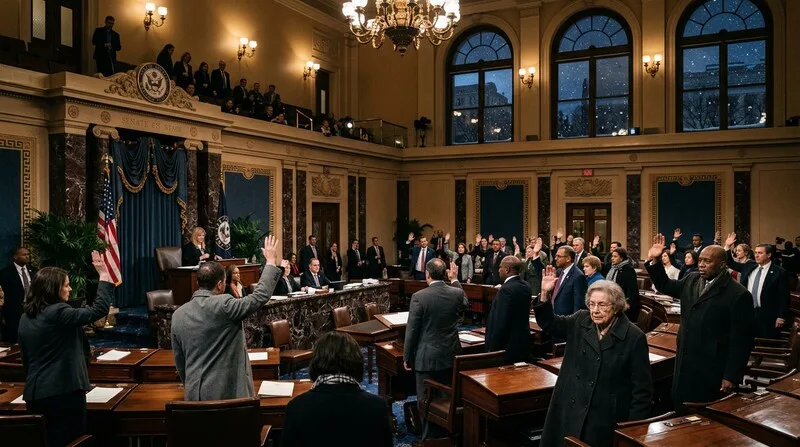
Murkowski
- Trump won non-metropolitan counties by 35+ points in 2024 — a tripling of the rural Republican margin since 2008 — making rural America the GOP's most reliable geographic base.
- Agricultural tariffs hit rural export economies hardest: soybean, corn, and pork producers face retaliatory trade barriers that directly reduce farm income in Republican strongholds.
- DOGE-related USDA extension office cuts threaten rural communities' access to agricultural research, disaster assistance, and rural development programs they disproportionately rely on.
- Rural Medicaid exposure is the single largest policy vulnerability for Republicans in 2026 — rural hospitals' survival depends on Medicaid funding that budget reconciliation would reduce.
- Collins and Murkowski demonstrate that personal-vote moderates can win rural-state Senate seats — but their model requires constant deviation from party line on healthcare and social issues.
The Scale of Rural Republican Dominance
The Republican advantage in rural America is one of the most durable and structurally embedded facts of contemporary American politics. In 2024, Trump won counties classified as non-metropolitan by the Office of Management and Budget by an average margin of more than 35 points. That represents a tripling of the rural Republican margin since 2008, when Barack Obama lost rural counties by only 12 points. The shift has been linear: each election cycle since 2008 has seen the rural Democratic vote erode, with the sharpest drops occurring in 2016 and 2020.
The causes of rural realignment are well-documented: the decline of manufacturing and mining industries that had union-affiliated Democratic loyalty; the cultural sorting that pushed college-educated professionals toward urban areas and left rural communities with lower average educational attainment and higher Republican affiliation; and the increasing salience of identity and cultural issues that, post-2010, tracked more closely with Republican Party positioning.
The result is a rural electorate that is genuinely and deeply Republican — not a swing electorate in any conventional sense. Democrats are not competing for rural votes; they are managing a floor. But even within a 35-point Republican advantage, a 5–8 point softening has consequences: it affects House races in rural-adjacent suburban districts, it affects Senate races in small-population rural states, and it creates internal Republican dynamics when the policy agenda visibly harms rural constituents.
Tariffs and the Agricultural Export Hit
The Trump administration's tariff policy is creating direct economic pressure in rural agricultural communities — the communities most solidly in the Republican base. The mechanism is well-established from the first Trump term's trade war with China (2018–2019): American tariffs on Chinese goods trigger retaliatory Chinese tariffs on American agricultural exports. China is the largest or second-largest export market for soybeans, corn, pork, and tree nuts — the primary income sources for rural Midwest and Southeast farm operations.
Early 2026 data from USDA trade tracking shows soybean exports to China down approximately 25 percent year-over-year. Pork export volumes are under similar pressure. Corn futures have declined from 2025 highs. Farm income projections from the USDA Economic Research Service have been revised downward for 2026 relative to the baseline published in early 2025.
Rural farmers are not, in the main, about to switch parties over tariffs. The political loyalty runs deep, and farmers largely support the broader Republican trade agenda even when it costs them directly — a pattern that held during the 2018–2019 trade war despite significant farm income losses. But tariff impact generates a specific political effect: it suppresses enthusiasm, reduces small-dollar agricultural donor activity, and creates an opening for Democratic messaging in rural-adjacent competitive districts. It also generates political noise that Republican incumbents must manage rather than ignore.
"Soybean exports to China are down 25 percent. Pork is under pressure. Farm income projections have been revised downward. Rural farmers are not switching parties — but they are watching."
USDA Economic Research Service | USDA trade data — Q1 2026
DOGE and the USDA Extension Office Cuts
The USDA's Cooperative Extension System — a network of county-level agricultural extension offices that provide direct technical assistance to farmers — is among the federal programs most visibly affected by DOGE-related workforce reductions. Extension agents advise farmers on crop disease identification, pest management, soil health, irrigation efficiency, farm succession planning, and dozens of other practical topics. In rural communities where private agricultural consulting is too expensive or unavailable, the county extension office is often the farmer's only technical resource.
Federal cuts to USDA staffing in 2025–2026 have reduced extension office capacity in dozens of counties across the Midwest and South. Some offices have been reduced to part-time coverage. Others have closed entirely, with services nominally transferred to state-level staff who lack the local presence to replicate what county agents provided.
This is not an abstract policy change. Farmers who have used extension services for decades — many of whom are lifelong Republicans — are directly experiencing the removal of a government service they valued. Farm Bureau chapters in Iowa, Indiana, and Kansas have formally raised concerns with Republican congressional offices about extension cuts. The political response from Republican legislators has been to seek exemptions or restorations for agricultural extension — an acknowledgment that this specific DOGE cut is politically untenable in rural districts.
Rural Healthcare: The Medicaid Double Vulnerability
Rural America has an acute healthcare infrastructure problem that predates the current administration. Rural hospital closures have been accelerating since 2010. The Chartis Center for Rural Health estimates more than 170 rural hospitals are at immediate closure risk as of 2026 — the highest number ever recorded. Many of these facilities operate in communities where the nearest alternative hospital is 50 to 100 miles away.
Medicaid is the financial lifeline for many of these facilities. Rural populations have higher rates of Medicaid enrollment than urban or suburban populations — reflecting lower average incomes, higher rates of disability, and a higher proportion of elderly patients who rely on Medicaid for long-term care costs. Any reduction in Medicaid reimbursement rates or eligibility creates immediate financial pressure on rural hospitals that are already operating at or near breakeven.
The political dynamic is notable: rural communities that vote Republican by 30+ points are also the communities most financially dependent on Medicaid. Republican voters in rural Kansas or rural Mississippi would directly experience the consequences of the Medicaid cuts their elected representatives are being asked to support. This creates a rare instance where Republican policy and Republican constituent interest are in direct conflict — a conflict visible enough that rural-state Republican senators have been the primary source of internal party resistance to the most aggressive Medicaid reduction proposals.
"Rural communities vote R+35. They also have the highest Medicaid dependency rates, the most hospitals at closure risk, and the most to lose from USDA extension cuts. That is not a sustainable combination."
Chartis Center for Rural Health | Kaiser Family Foundation | USDA ERS — 2026
The Collins/Murkowski Exception: When Personal Vote Beats Party Brand
Not all rural-state Republican senators behave identically. Susan Collins of Maine and Lisa Murkowski of Alaska represent a distinct political type: moderate Republicans in small-population, heavily rural states who have built personal vote margins that significantly exceed the national Republican brand. Collins won Maine in 2020 when Biden carried the state by 9 points. Murkowski won Alaska in 2022 using ranked-choice voting in a state that had elected her via write-in campaign.
The survival strategies of Collins and Murkowski illustrate the ceiling of pure partisan loyalty in rural Senate races. Both senators have built their brands on constituent service, moderate positioning on healthcare and social issues, and willingness to break with the national party on specific votes that would directly harm their constituents. Both have been notably vocal in 2026 about Medicaid cuts and USDA staffing reductions — political positioning that reflects their understanding of their own electoral math rather than party unity.
Their behavior is a template for Republican incumbents in rural-adjacent competitive districts who face the same tension between national party agenda and constituent vulnerability.
The 2026 Rural Senate Map
The directly competitive rural Senate races in 2026 are limited. Most deeply rural states are Safe Republican — the structural partisan alignment is too dominant for near-term Democratic competitiveness.
The Significance of Rural Enthusiasm, Not Rural Switches
The rural vote in 2026 is unlikely to swing dramatically toward Democrats. The structural partisan alignment is too deep, the cultural sorting too complete, and the alternative — voting for the national Democratic Party — too foreign to rural community political identity. What can change is enthusiasm and turnout. A rural Republican base that feels specifically harmed by tariff impacts on their commodity prices, that sees the county extension office close, that watches the local hospital struggle under Medicaid pressure — that base may not defect, but it may stay home in greater numbers than typical. In a midterm where Republican turnout is already under pressure from a difficult national environment, a turnout softening even of 3–5 points in rural precincts would meaningfully compound Democratic gains in rural-adjacent suburban and exurban districts. That is the mechanism by which rural Republican vulnerability translates into 2026 electoral consequences — not switches, but absence.

Video Analysis
NBC News analyst Steve Kornacki analyzes how the structural midterm environment interacts with rural Republican advantages — and where the limits of rural overperformance emerge.
Frequently Asked Questions
How dominant is the Republican advantage in rural America?
Republicans won rural counties by an average of 35 or more points in 2024 — triple the 12-point margin from 2008. The shift has been linear across each election cycle since 2008, driven by manufacturing decline, cultural sorting, and increasing salience of identity issues that align with Republican positioning.
How are tariffs affecting rural agricultural communities?
Retaliatory tariffs have reduced soybean exports to China by approximately 25 percent year-over-year. Pork exports are down 18 percent. Corn futures have declined from 2025 highs. USDA farm income projections for 2026 have been revised downward. Rural farmers are not switching parties, but the economic pressure is generating internal Republican political noise.
What is DOGE doing to USDA agricultural extension services?
USDA workforce reductions have closed or reduced services at dozens of county agricultural extension offices across the Midwest and South. These offices provide crop disease identification, soil testing, irrigation guidance, and farm business support — often the only technical resource available to small and mid-sized rural farms. Farm Bureau chapters in Iowa, Indiana, and Kansas have formally objected to Republican congressional offices.
Which rural Senate seats are at stake in 2026?
Iowa's open seat (Grassley retired) is the only rural Senate race with any competitive potential, rated Lean R. Montana (Daines) and West Virginia (open) are Safe R. Collins in Maine and Murkowski in Alaska are Likely R, with both senators publicly raising concerns about Medicaid cuts and USDA reductions in explicit acknowledgment of their rural constituent exposure.