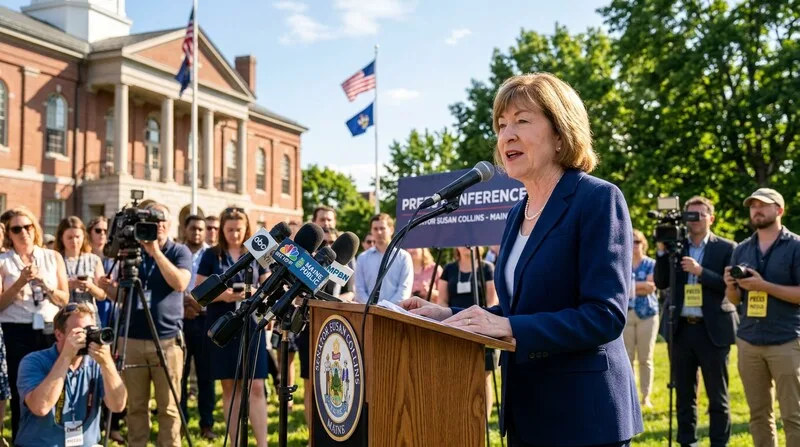
- Collins has won every Senate election in Maine since 1996, consistently running 8-15 points ahead of Republican presidential candidates — the largest persistent personal-vote gap of any Republican senator in a blue state.
- Maine's D+7 presidential lean creates the central tension: how long can a Republican incumbent sustain personal-vote advantages in a state trending further Democratic each cycle?
- The Medicaid vote trap is Collins' most acute vulnerability: Maine has one of the highest Medicaid-to-population ratios in New England, and any vote supporting Medicaid cuts would be used heavily in attack ads.
- Jared Golden — the only House Democrat to vote against the ACA in 2021 — is the one Democrat whose profile could break Collins' coalition, combining rural Maine authenticity with crossover credibility.
- Three scenarios: Collins wins comfortably with personal-vote advantage intact; Golden makes it competitive but Collins survives; Golden wins as Collins' brand cracks over Medicaid or Trump-related votes.
Collins' Historical Margins vs. Maine Presidential Results
The data below shows the remarkable gap between Collins' personal support and Maine's partisan lean. She has consistently won by margins far exceeding what any Republican presidential candidate achieves in Maine — a phenomenon that reflects genuine crossover voting from Democrats and independents who distinguish between Collins and her party.
| Year | Collins Margin | ME Presidential (same cycle) | Collins vs. R Pres. | National Environment | Key Issue |
|---|---|---|---|---|---|
| 2002 | +41.6 | R+5 (2000) | +36.6 | R wave (post-9/11) | Terrorism, defense |
| 2008 | +23.0 | D+17 (Obama) | +40.0 | D wave (financial crisis) | Economy, Iraq |
| 2014 | +37.2 | D+15 (Obama 2012) | +52.2 | R wave (ACA backlash) | ACA, economy |
| 2020 | +8.6 | D+9 (Biden) | +17.6 | D wave (COVID) | Kavanaugh, healthcare |
| 2026 | TBD | D+9 (Biden 2020) | TBD | Likely D-leaning | Medicaid cuts, RCV |
*Collins' smallest margin advantage over the Republican presidential candidate came in 2020, when she still outran Trump by 17.6 points. Her survival formula requires this crossover to hold at some level even in hostile environments.

The Medicaid Vote Trap
Collins' political identity rests on a specific promise she has made explicitly and implicitly over five terms: she will vote to protect healthcare. In 2017, when Senate Republicans brought the ACA repeal bill to the floor, Collins joined John McCain and Lisa Murkowski in voting no — killing the bill. She cited Maine's Medicaid expansion and the healthcare as an issue funding consequences. Maine voters had passed Medicaid expansion by ballot initiative the same year, over their Republican governor's objection, which made the healthcare issue unusually personal and democratic in Maine's political context.
The 2025 Medicaid reconciliation bill's Medicaid provisions recreate 2017's dynamic in a more constrained form. Collins cannot fully repeat her 2017 move — a simple no vote on a reconciliation bill would carry larger political costs from Senate Republican leadership — but she cannot vote for per-capita caps or work requirements without directly breaking her stated commitment to Medicaid. The political trap is precisely constructed: national Republicans need her vote, Maine voters will track her vote, and there is no procedural maneuver available that lets her claim credit for protecting Medicaid while supporting the overall package. Her vote will be the defining moment of her 2026 campaign before a single ad runs.
Three Scenarios for 2026
Democrats Nominate a Weak Candidate
If Jared Golden declines to run and Democrats nominate a progressive or a lower-profile candidate, Collins' brand advantage reasserts itself. A candidate from Portland's progressive wing gives Collins the same contrast she has exploited for five terms: a Senate institution versus a partisan liberal. Under RCV, even multiple challengers consolidate eventually, but if the strongest Democratic challenger is not a rural-credentialed candidate, Collins' Macomb-style crossover coalition holds and she wins by mid-single digits. Probability depends heavily on who enters the Democratic primary.
Three-Way Race, Golden Wins Round 2
A three-way race with Collins, Golden, and an independent (perhaps a progressive running left of Golden) plays into RCV's consolidation mechanics. Golden's rural appeal and independent-leaning voters who rank him first but don't want Collins could deliver him a majority in round two even if Collins leads in first-round counts. This is the scenario RCV was designed for: a moderate challenger whose real level of support is higher than his first-round vote share because of ranked preference patterns from non-Collins voters. Democrats have modeled this scenario and it is among their preferred paths to victory.
Golden Wins Outright in Round 1
A clean two-way race between Collins and a credible Democrat like Golden, in a D+8 to D+12 national environment driven by healthcare and economic anxiety, would be the most competitive Maine Senate race in two decades. Collins' crossover brand works best when she can position herself against a liberal caricature. Against Golden — who is pro-gun, fiscally conservative, and has won Trump-voting rural Maine voters — she cannot run that contrast. If she also voted for Medicaid cuts, the race is genuinely competitive. Forecasters currently rate this scenario at roughly 30-35% probability, rising if Golden announces a candidacy.
Jared Golden: The One Democrat Who Changes Everything
Golden served three terms in Maine's 2nd Congressional District, a sprawling rural and small-city district that Trump carried by 6 points in 2020 and by roughly 14 points in 2024. He won re-election in 2022 in that environment by running as a genuine economic populist and social moderate. He voted against the American Rescue Plan, against some progressive spending packages, and in favor of several Republican-backed measures on guns and agriculture. He also voted for the Infrastructure Investment and Jobs Act and several healthcare expansions. His record is not Democratic orthodoxy — it is a genuine attempt to represent a mixed district.
That record is simultaneously his greatest asset and his biggest primary vulnerability. Maine Democratic primary voters skew more progressive than Golden's voting history. He would need to win a primary against likely opposition from the party's progressive wing before facing Collins. Under Maine's RCV primary system, however, a plurality is not enough — he would need broad coalition support. The question is whether Maine Democrats are willing to nominate their most electable candidate over their most ideologically aligned candidate. The national environment in 2026 gives the "electability" argument unusual force: a Democratic primary in a competitive state during an anti-incumbent national wave is not the moment for ideological purity. Whether that logic prevails in Maine's Democratic primary determines whether Collins faces her most dangerous challenger or her most manageable one.