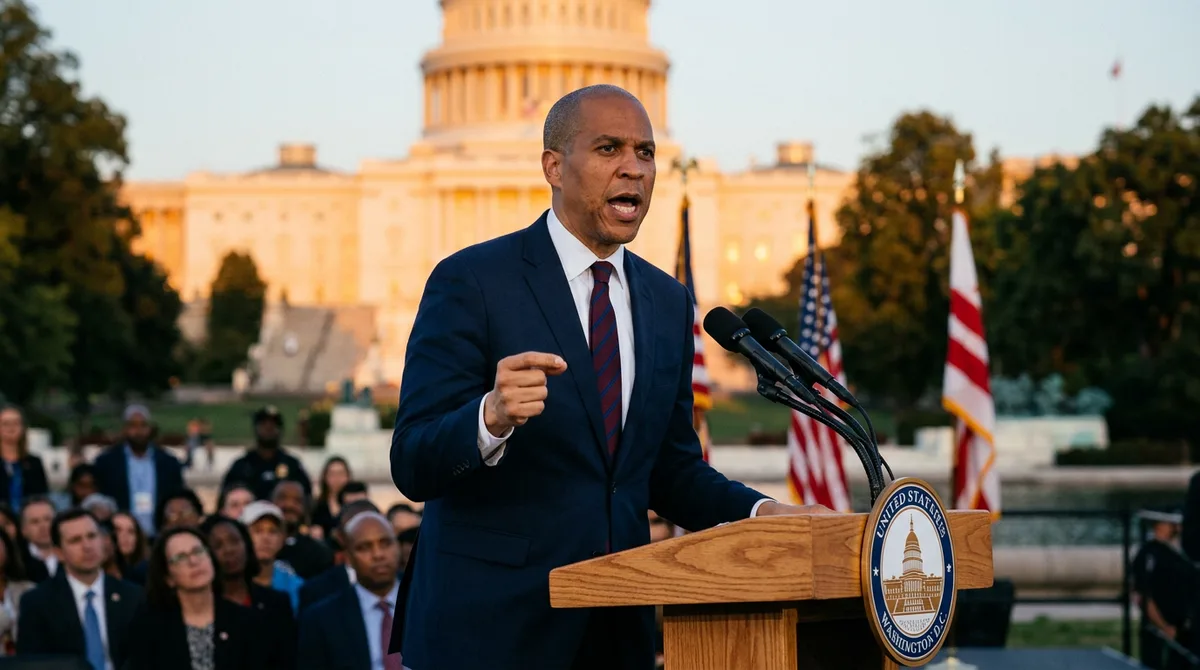

From Capitol Cleanup to the Senate
Andy Kim entered the national consciousness on January 7, 2021 — the morning after the Capitol attack — when photographs showed him on his hands and knees picking up debris in the Capitol Rotunda, wearing a suit, after the rioters had left. The image became iconic: a congressman cleaning up the mess left by political violence, silently. It captured something about Kim that his constituents had already recognized through his House career in a competitive New Jersey swing states — a genuine, somewhat old-fashioned sense of public service obligation that felt out of step with the performative politics of the Trump era.
Kim's biography is the product of New Jersey's Korean-American community and America's academic elite. Born to Korean immigrant parents in Massachusetts, he grew up in New Jersey, won a Rhodes Scholarship to Oxford, and returned to earn a PhD from Oxford before joining the State Department and eventually the National Security Council. He served under both Obama and Trump administrations as a director for Afghanistan and Pakistan policy — unusual experience that gives him a sophisticated understanding of U.S. foreign policy that most senators acquire slowly over years on the Foreign Relations Committee, if at all.
His decision to challenge Bob Menendez after the 2023 indictment was politically brave and institutionally correct. Menendez's corruption — gold bars stored at home, envelopes of cash, an Egyptian government connection — was breathtaking in its brazenness, and many New Jersey Democrats initially hesitated to move against him given his long dominance of the state's Democratic politics. Kim moved first and moved loudly. By the time Menendez was convicted in July 2024, Kim had already locked up the Democratic establishment behind him and was the clear frontrunner for the Senate majority Menendez had held since 2006.
- Andy Kim (D-NJ) won New Jersey's open Senate seat in 2024 by 13 points, defeating Republican Curtis Bashaw in a race that followed Bob Menendez's federal conviction and resignation.
- New Jersey is D+7 — a competitive mid-Atlantic state that leans Democratic at the statewide level but has swung Republican in governor's races, making Kim's Senate race a key Democratic hold.
- He represented NJ-3 (Burlington/Ocean Counties) for three terms from 2019-2025 — a competitive district he won repeatedly in a purple area, and became nationally known for picking up trash in the Capitol on January 6th.
- Kim is a Rhodes Scholar and former State Department diplomat with a background in Afghanistan and Iraq policy — his foreign policy expertise positions him as a future voice on the Senate Foreign Relations Committee.
Key Policy Areas
National Security Expert
Kim's NSC background on Afghanistan and Pakistan policy gives him genuine foreign policy expertise. He is a strong supporter of NATO commitments, Ukraine aid, and traditional alliance structures that Trump has questioned. His academic and professional background in foreign affairs will likely make him one of the Senate Democratic caucus's more credible voices on national security.
Anti-Corruption Voice
Kim's willingness to confront Menendez when others hesitated established his credentials as a genuine ethics reformer rather than a cynical opportunist. He has positioned himself as an advocate for restoring public trust in government institutions, calling for stronger financial disclosure rules and limits on conflicts of interest for elected officials.
Constituent-Focused Democrat
In his House career, Kim built a reputation for accessible, constituent-first service in a competitive swing states. He focused on healthcare costs, veterans' benefits, and local infrastructure — the kind of practical issues that win re-elections in competitive seats. As senator, he will continue prioritizing New Jersey's specific interests including Medicaid, pharmaceutical costs, and port and transit infrastructure.
Electoral History
| Year | Race | Result | Margin |
|---|---|---|---|
| 2024 | New Jersey Senate (general) | Kim 53.8% — Curtis Bashaw (R) 38.5% | D +15.3 |
| 2022 | NJ-03 House (re-election) | Kim 55.6% — Bob Healey (R) 42.6% | D +13.0 |
| 2020 | NJ-03 House (re-election) | Kim 51.4% — David Richter (R) 46.7% | D +4.7 |
| 2018 | NJ-03 House (open seat) | Kim 49.9% — Tom MacArthur (R, inc.) 49.2% | D +0.7 |
The Menendez Context
Bob Menendez served as New Jersey's senior senator since 2006 and was one of the most powerful Democrats in the Senate, chairing the Foreign Relations Committee. His 2023 federal indictment — alleging he accepted bribes including gold bars and cash in exchange for using his Senate position to benefit foreign governments and New Jersey businessmen — created a political crisis for New Jersey Democrats that many had hoped to manage quietly. Kim refused to manage it quietly.
The July 2024 guilty verdict on all counts removed any ambiguity. Menendez was expelled from the Senate Democratic caucus and ran as an independent in the general election, receiving less than one percent of the vote. Kim won easily against Republican Curtis Bashaw, a hotelier who never gained traction in a state where Trump's national unpopularity weighed on Republican candidates. Kim became, in January 2025, the first Korean-American ever elected to the U.S. Senate — a historic milestone that received less attention than it deserved given the focus on the Menendez saga that preceded it.
2026 Senate Battle
Sen. Andy Kim (D-NJ), elected to the Senate in November 2024, entered the upper chamber as Democrats began planning their path to majority control in the 2026 Senate elections. Kim, who previously represented NJ-3 in the House (2019-2025), brings a unique profile: a foreign policy expert and State Department veteran who defeated an entrenched incumbent through a grassroots primary campaign. His election came after Sen. Bob Menendez was convicted on federal bribery charges, creating a rare open seat in reliably Democratic New Jersey. Democrats need a net gain of four seats to retake the Senate majority, and Kim is expected to be a reliable Democratic vote while potentially serving on foreign policy-focused committees where his State Department background applies directly. The generic ballot currently favors Democrats significantly.