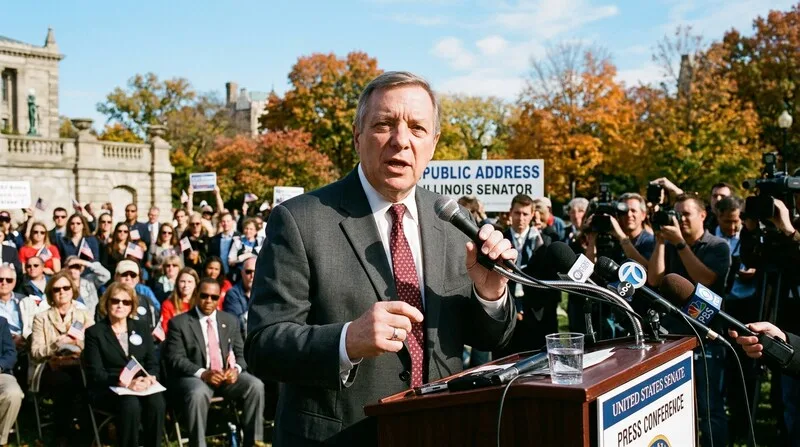
- Dick Durbin (D-IL) announced his retirement from the Senate in 2024 after serving since 1997 — the second-longest-serving Democratic senator in history and the longest-serving Democrat from Illinois, ending a 40+ year congressional career.
- He served as Senate Majority Whip (2005-2007, 2009-2021) and Senate Minority Whip — the number-two Democratic leadership position — making him one of the most senior members of the caucus and a central figure in legislation from the ACA to immigration reform.
- Durbin chairs the Senate Judiciary Committee in the 118th Congress and has used that role to advance progressive judicial nominations, criminal justice reform, and immigration legislation — his final two years focused on building Biden's judicial legacy.
- He is the co-author of the DREAM Act — first introduced in 2001, the bill providing a path to citizenship for undocumented immigrants brought to the US as children that has never passed the Senate despite bipartisan support and became the basis for Obama's DACA executive action.

Biography
Richard Joseph Durbin was born on November 21, 1944, in East St. Louis, Illinois, and has spent virtually his entire adult life in public service in his home state. He earned his undergraduate degree from Georgetown University and his law degree from Georgetown Law, working briefly for the office of Senator Paul Douglas before returning to Illinois to practice law and enter state politics. He served in the Illinois state legislature before winning election to the House of Representatives in 1982, serving seven terms in the House before winning the Senate majority vacated by Paul Simon in 1996. His Senate election victory made him one of the most prominent Democrats in a state that had been competitive for much of the postwar era but was rapidly becoming a Democratic stronghold.
Durbin rose steadily through Senate leadership, becoming Senate majority Whip in 2005 and Senate Majority Whip in 2007 when Democrats regained the majority — a position he held, alternating between majority and minority whip depending on which party controlled the Senate, for nearly two decades. He is the longest-serving Senate whip in American history. As whip, his job was fundamentally about vote-counting, persuasion, and keeping the Democratic caucus unified on critical legislation, a task he performed with notable skill across some of the most contentious legislative periods in modern history including the passage of the Affordable Care Act and the Biden-era legislative agenda.
Beyond his leadership role, Durbin built a reputation as one of the Senate's most consequential liberal voices on immigration, criminal justice, and civil liberties. His authorship of the DREAM Act, which he first introduced in 2001 to provide a pathway to citizenship for undocumented immigrants brought to the US as children, defined a major portion of his legacy even as the legislation repeatedly failed to pass as a standalone bill. He announced in 2024 that he would not seek re-election in 2026, opening the Illinois Senate seat for the first time since 1996 and removing the most senior Democrat from the chamber.
Key Policy Positions
Immigration & the DREAM Act
Durbin has been the Senate's most consistent champion of immigration polling for undocumented immigrants brought to the United States as children. He introduced the DREAM Act in 2001 alongside Republican Senator Orrin Hatch, a bipartisan proposal that reflected the pre-polarization era of immigration politics. The bill repeatedly passed the House or came close to Senate passage before dying in procedural votes or presidential vetoes. Obama's Deferred Action for Childhood Arrivals (DACA) executive action in 2012 accomplished some of what the DREAM Act sought; Durbin consistently pushed for a legislative solution that would permanently protect DACA recipients. His decade-plus advocacy for this population defined his brand as an immigration liberal at a time when the issue became one of the most polarizing in American politics.
Financial Reform & Consumer Protection
The Durbin Amendment, embedded in the 2010 Dodd-Frank Wall Street Reform Act, was one of his most consequential and economically significant legislative achievements. The amendment gave the Federal Reserve authority to cap the interchange fees that banks charge retailers for debit card transactions, a reform fought bitterly by the banking industry. It was estimated to save retailers tens of billions of dollars annually, costs that were at least partially passed on to consumers. The banking industry argued the amendment reduced bank revenue and harmed consumers by reducing free checking account availability; consumer advocates argued it was a major blow against bank oligopoly power. Durbin's willingness to take on the banking industry — which has enormous lobbying power in Washington — reflected his positioning as a progressive populist within the broader Democratic coalition.
Criminal Justice & Civil Liberties
Durbin was an early Democratic voice for criminal justice reform, working across partisan lines on sentencing reform legislation including the Fair Sentencing Act of 2010, which reduced the sentencing disparity between crack and powder cocaine offenses — a disparity that civil rights groups had long argued had a racially discriminatory impact. He also supported the First Step Act of 2018, a bipartisan criminal justice reform bill signed by President Trump that reduced mandatory minimum sentences for nonviolent drug offenses. His work on the Judiciary Committee over decades gave him deep involvement in civil liberties issues ranging from surveillance law to detainee treatment at Guantanamo, where he was one of the first senators to call for the facility's closure after the Abu Ghraib scandal.
Career Timeline
| Year | Event |
|---|---|
| 1983 | Elected to the US House of Representatives from Illinois 20th District |
| 1996 | Won Senate seat vacated by Paul Simon; defeated Republican Al Salvi |
| 2001 | Co-introduced the DREAM Act with Sen. Orrin Hatch (R-UT) |
| 2005 | Became Senate Minority Whip — began longest whip tenure in Senate history |
| 2010 | Durbin Amendment included in Dodd-Frank; Fair Sentencing Act signed |
| 2014 | Re-elected with 53% in competitive midterm environment |
| 2021 | Became Senate Majority Whip under Biden; key negotiator on BBB and IRA |
| 2024 | Announced retirement; will not seek sixth Senate term in 2026 |
Illinois Open Seat: 2026 Context
Durbin's retirement creates an open Senate seat in Illinois for the first time in 30 years. Illinois has been a reliable Democratic state in statewide elections since the 1990s. No Republican has won a Senate race there since Peter Fitzgerald in 1998. Democratic presidential candidates have carried Illinois by double digits in every election since 2000. The state's political geography — a massive Democratic advantage in the Chicago metro area overwhelming Republican strength in downstate rural counties — makes it structurally favorable for Democratic Senate candidates.
The primary contest for the Democratic nomination is likely to be the decisive race. Multiple Illinois Democrats have explored the race. The Republican Party faces the challenge of finding a credible statewide candidate in a state where their brand has struggled badly. Analysts rate the seat as safe Democratic barring an extraordinary national environment, though the open-seat status creates marginally more uncertainty than a Durbin incumbency would have.