The Whiteboard Professor Who Went to Congress
Katie Porter arrived in Washington in 2019 with a background that was genuinely unusual for Congress: she was a consumer bankruptcy law professor at the University of California, Irvine, who had been a student of Elizabeth Warren and had co-authored academic work on household financial distress. She won a seat in a traditionally Republican Orange County district by running on healthcare and economic accountability, flipping a seat that had not sent a Democrat to Congress in decades.
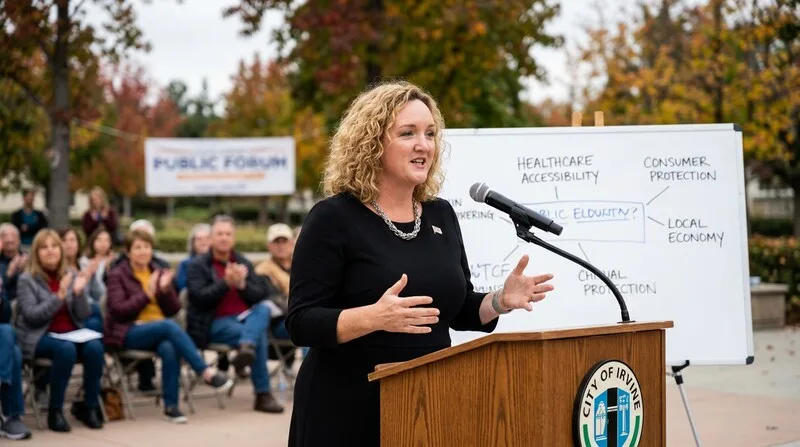
What made her nationally famous was her use of a whiteboard in congressional hearings. The technique was simple: when a bank CEO or pharmaceutical executive explained that their company could not afford to raise wages or lower drug prices, Porter would take out her whiteboard and do the arithmetic publicly, showing on the spot how the numbers did or did not add up. The clips went viral in a media environment starved for authentic congressional accountability. A 2019 exchange with JPMorgan Chase CEO Jamie Dimon — in which Porter calculated that a full-time JPMorgan teller in her district could not afford basic expenses on her salary — earned tens of millions of views and established her brand as a fearless questioner of corporate power.
Porter won re-election twice in her Orange County district, demonstrating that a progressive Democrat could hold competitive California suburban territory. She became one of the top small-dollar fundraisers in Congress, drawing donations from progressive activists across the country who valued her accountability hearings as much as her local constituents did.
- Katie Porter (D-CA) served three terms representing California's 47th Congressional District (Orange County suburbs) before losing the 2024 California Senate primary to Adam Schiff by 20 points, ending her electoral career.
- She became nationally known for her whiteboard questioning style in House hearings — using detailed visual aids to challenge corporate CEOs, bank executives, and federal officials in memorable viral exchanges that built her a massive grassroots donor base.
- Porter was a consumer protection law professor at UC Irvine and a protégé of Elizabeth Warren — her academic and legal background in housing law and financial regulation drove her legislative focus on debt, healthcare costs, and corporate accountability.
- CA-47 is a competitive suburban Orange County district she flipped from Republican in 2018 — a sign of the educational realignment that transformed Orange County from Reagan country to a Democratic-leaning suburban battleground.
The 2024 Senate Race and What Comes Next
Porter left her safe House majority in 2023 to run for the California Senate majority being vacated by Dianne Feinstein, who died in office. She ran as the progressive alternative to Representative Adam Schiff, who had the backing of much of the Democratic establishment and Governor Gavin Newsom's support. Under California's top-two primary, Porter advanced to the general election alongside Schiff but lost the November race convincingly: Schiff won with 56.7% to Porter's 43.3%.
The loss was significant but did not end her Senate ambitions. Porter announced she is running for the California Senate majority held by Alex Padilla, whose term expires in 2026. The race will again test whether her progressive grassroots coalition can compete statewide against candidates backed by the California Democratic establishment. Padilla is an incumbent with strong ties to the party machine; beating him will require Porter to both consolidate the progressive wing and peel off enough mainstream Democratic voters to finish in the top two of the California primary.
Her national small-dollar fundraising network gives her a financial foundation that most challengers to incumbents cannot match. The question is whether the whiteboard brand — built in committee hearings — translates into the sustained ground-level organizing required to win a statewide California primary against an incumbent senator.
Key Policy Positions
CFPB Defender
Porter is one of the most vocal defenders of the Consumer Financial Protection Bureau in Congress. Her academic work on consumer bankruptcy and her mentorship under Elizabeth Warren — who created the CFPB — give her credibility on financial regulation that few members can match. She has repeatedly used hearings to challenge banks, credit card companies, and pharmaceutical firms on pricing and fee practices.
Medicare for All Supporter
Porter supports Medicare for All as the long-term goal for American healthcare, placing her on the left flank of the Democratic Party on this issue. She has also focused on prescription drug pricing, using hearings to question pharmaceutical executives about drug cost calculation and the gap between R&D spending and retail prices. She supported the Inflation Reduction Act's drug pricing provisions as a meaningful but insufficient step.
Affordability Focus
Porter has made housing affordability a central theme, particularly relevant in California where she has seen firsthand the cost-of-living pressures on working-class families in her Orange County district. She supports increased federal investment in affordable housing construction and tenant protections, and has used her whiteboard technique to illustrate the gap between wages and housing costs in major California markets.
Electoral History
| Year | Race | Result | Outcome |
|---|---|---|---|
| 2026 | California U.S. Senate (vs. Padilla) | TBD | Running; challenging incumbent |
| 2024 | California U.S. Senate (general) | Schiff 56.7% — Porter 43.3% | Lost to Schiff |
| 2022 | California 47th District (general) | Porter 53.5% — Scott Baugh (R) 46.5% | Won; competitive race |
| 2020 | California 45th District (general) | Porter 53.6% — Greg Raths (R) 46.4% | Won re-election |
| 2018 | California 45th District (general) | Porter 52.1% — Mimi Walters (R inc.) 47.9% | Flipped seat; first win |
2026 California Senate Race Outlook
California's Senate seat held by Alex Padilla is rated Safe Democratic in the presidential context, but the Democratic primary is a genuine contest. Porter will try to consolidate the progressive base — the same voters who supported Bernie Sanders and Elizabeth Warren in presidential primaries — and position herself as the authentic working-class voice against a more establishment incumbent. Padilla has strong relationships with California's Democratic donor class and the party apparatus.
The top-two primary format creates strategic complexity. Porter needs to finish in the top two among potentially many Democratic candidates. If the progressive vote fragments or if another well-funded challenger enters, she could find herself squeezed. Her path requires demonstrating early that she is the viable progressive alternative, consolidating that lane before the primary, and then making a case to general-election Democrats that her accountability brand makes her the stronger candidate in November.
California is safely Democratic in any general election. The question is which Democrat. Porter's national profile, small-dollar fundraising machine, and genuine consumer protection credentials give her a real but not certain path.