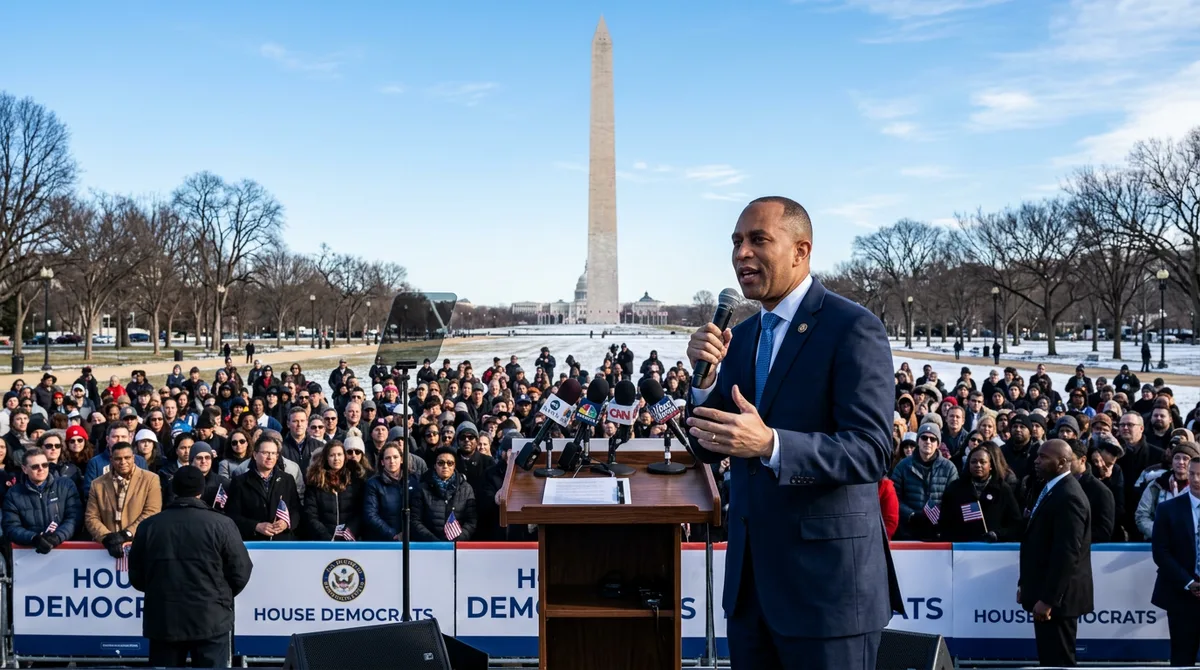
- Pramila Jayapal (D-WA) chairs the Congressional Progressive Caucus — the largest ideological caucus in the House with 100+ members — and represents Washington's 7th Congressional District (Seattle) in a D+37 safe seat.
- She is the first Indian-American woman elected to the House and was born in Chennai, India — coming to the US as a student and becoming a citizen before her political career, making her immigration background central to her advocacy.
- Jayapal has been the leading House progressive voice on Medicare for All — authoring the House version of the single-payer healthcare bill and making it a flagship Progressive Caucus priority despite its limited path to passage in a divided Congress.
- She led the Progressive Caucus's leverage strategy in 2021 — initially threatening to vote against the bipartisan infrastructure bill unless it was paired with the Build Back Better reconciliation package, a negotiating tactic that reshaped how both bills moved through Congress.
Biography
Pramila Jayapal was born on September 21, 1965, in Chennai (then Madras), India, and came to the United States at age 16 to attend Georgetown University, where she studied English. She went on to earn an MBA from Northwestern University's Kellogg School of Management and built a career as a healthcare consultant before redirecting her professional focus toward social justice organizing. She became a US citizen in 2000, and her path to citizenship — navigating an immigration system she experienced as bureaucratically hostile and dehumanizing — became the foundation of her most sustained policy advocacy. She founded OneAmerica in 1999, which grew into one of the largest immigrant rights organizations in Washington State, and led it for more than a decade before running for office.
In 2014 she was elected to the Washington State Senate, representing the 37th district in south Seattle. In 2016, when Jim McDermott retired from Washington's 7th congressional district — the Seattle-centered seat he had held since 1989 — Jayapal ran and won the Democratic primary against a crowded field and won easily in the general election. She entered Congress in January 2017, immediately positioning herself as part of the progressive wing of the Democratic caucus and taking an active role in the Congressional Progressive Caucus. She was elected to lead the CPC in 2019, becoming chair of a caucus with more than 100 members and the largest ideological caucus in the House. Her chairmanship coincided with the Biden administration's legislative agenda, giving the progressive caucus unusual leverage in shaping Democratic priorities during the 117th and 118th Congresses.
She is the first South Asian woman elected to Congress, the first Indian-American woman in the House, and one of the most institutionally powerful members of the progressive movement in Congress, combining ideological commitments with strategic sophistication and organizational skill in ways that distinguish her from more rhetorically prominent but institutionally marginal progressive voices.
Key Policy Positions
Medicare for All
Jayapal is the House lead sponsor of the Medicare for All Act and has been the most strategically persistent advocate for single-payer healthcare in Congress. Her version of the bill would eliminate private insurance and create a government-administered single-payer system covering all Americans for medical, dental, vision, and long-term care services. She has held numerous hearings on the legislation, published detailed legislative language, and countered cost arguments with analyses showing net savings from eliminating insurance industry overhead and pharmaceutical pricing leverage. She has consistently resisted public option proposals as insufficient, arguing they leave the private insurance structure intact and entrench a two-tier system. Her advocacy has moved Medicare for All from a fringe position to a mainstream progressive one over the course of her congressional tenure, though it remains far from enactment.
Immigration Reform
Jayapal's immigration advocacy predates her congressional career by more than a decade. As an immigrant herself and the founder of one of Washington State's largest immigrant advocacy organizations, she brings unusual personal and professional depth to immigration polling debate. She is the lead sponsor of the US Citizenship Act, the most comprehensive immigration polling legislation introduced in the 118th Congress, which would create a pathway to citizenship for the estimated 11 million undocumented people in the United States, eliminate the diversity visa lottery backlog, expand refugee admissions, and overhaul enforcement priorities. She has also been a consistent critic of immigration detention, pushed for the humane treatment of asylum seekers, and opposed immigration polling programs that she argues are based on racial profiling. Her district — Seattle — is a sanctuary city and one of the most immigrant-friendly urban areas in the country.
Economic Policy & Labor
Jayapal represents one of the most economically dynamic congressional districts in the country — Seattle is home to Amazon, Boeing, and Microsoft, as well as some of the most active labor organizing in the country, including the SEIU-organized hotel and healthcare workers and the nascent Amazon Labor Union. Her economic positions reflect this context: she supports higher corporate taxes, a robust union rights framework including the PRO Act to strengthen collective bargaining, a $20 minimum wage, student debt cancellation, and significant public investment in climate infrastructure and clean energy. She has been particularly focused on the economic concentration concerns posed by the tech industry, supporting antitrust enforcement against large technology companies and pushing for stronger data privacy protections. She has also engaged seriously with the economic disruptions that automation and AI may cause to working-class employment, arguing for policies that ensure the gains from technological change are broadly distributed rather than captured by capital owners.
Congressional Elections, WA-7
| Year | Race | Result | Context |
|---|---|---|---|
| 2016 | General Election, WA-7 | ~86% | Won open seat after McDermott retirement; first South Asian woman in House |
| 2018 | General Election | ~85% | Re-elected; took over Progressive Caucus chair 2019 |
| 2020–2024 | General Elections | Win | Re-elected each cycle in safe D Seattle seat |
Washington's 7th is one of the most reliably Democratic districts in the country, covering Seattle and its western suburbs. WA uses a top-two primary system where the two candidates with the most votes advance to the general regardless of party. Jayapal consistently finishes atop the primary field and faces no meaningful general election competition.
Political Standing & Progressive Caucus Leadership
Pramila Jayapal occupies a distinctive position among progressive Democrats: she combines the ideological commitments of the Squad's most prominent voices with a more institutional orientation and strategic sophistication that comes from leading a 100-member caucus rather than functioning primarily as an individual gadfly. The Congressional Progressive Caucus under her leadership has made serious attempts to function as a legislative bloc — threatening to withhold votes to extract policy concessions, developing detailed legislative alternatives rather than simply opposing centrist proposals, and building the organizational infrastructure necessary to coordinate large numbers of members.
The record of that strategy is mixed. The most visible test — the 2021 infrastructure/Build Back Better negotiations — ended with the progressive caucus declining to block the infrastructure bill, which passed without a guaranteed vote on the larger social spending package. Joe Manchin then killed the larger package. Jayapal and her allies argue that the Inflation Reduction Act that eventually passed reflected progressive pressure; critics argue the caucus's leverage was mismanaged. She remains one of the most strategically important progressive members in the House, and as the minority, her influence over Democratic positioning on Medicare for All, immigration, and economic policy will likely grow as the party prepares for the 2026 and 2028 election cycles.