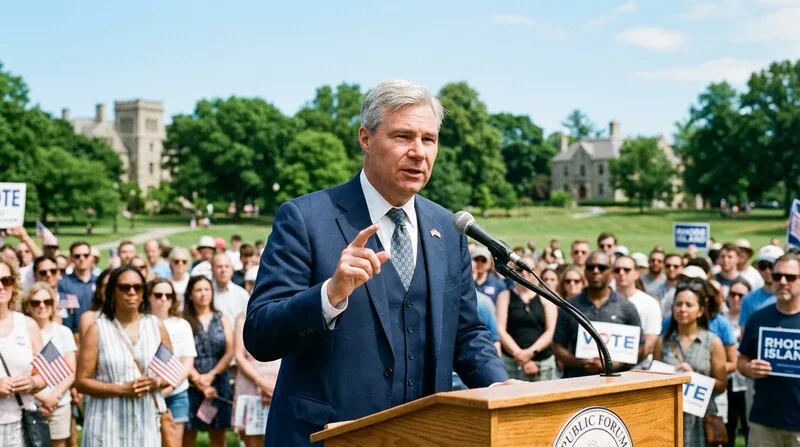
- Sheldon Whitehouse (D-RI) has served as Rhode Island’s senior senator since 2007, building one of the most distinctive Senate profiles through 200+ consecutive weekly floor speeches on climate change spanning more than a decade.
- He chaired the Senate Budget Committee during the Democratic majority and serves on the Judiciary and Environment and Public Works committees, giving him influence on both judicial nominations and environmental policy.
- Whitehouse has pursued aggressive investigations into dark money influence on the Supreme Court and conservative legal networks, a focus that put him in direct confrontation with Republican colleagues during multiple confirmation hearings.
- Re-elected in 2024 to a fourth Senate term, Whitehouse’s next election is not until 2030 in a safely Democratic Rhode Island that Biden won by 21 points. He is free to focus on national policy priorities without near-term electoral pressure.

Biography & Career
Sheldon Whitehouse was born on October 20, 1955, in New York City, into a diplomatic family. He grew up in various countries where his father served as a US diplomat. He attended Yale University for his undergraduate education and then the University of Virginia School of Law. After law school, he clerked for a federal judge and then entered Rhode Island public service, eventually becoming a partner at a Providence law firm and serving in various state government roles.
He was appointed Rhode Island US Attorney in 1994 by President Clinton, serving in that role through 1998. He then served as Rhode Island Attorney General from 1999 to 2003, gaining prosecution experience and a statewide political profile. He ran unsuccessfully for governor in 2002 and ran for Senate in 2006, defeating incumbent Republican Lincoln Chafee in a Democratic wave year. He has been re-elected in 2012, 2018, and 2024 by comfortable margins in one of the most reliably Democratic states in the country.
In the Senate, Whitehouse has developed two signature issues that define his national profile: climate change and dark money in politics. Beginning in 2012, he started giving weekly floor speeches on climate science and policy — a streak that eventually exceeded 200 speeches and made him the Senate’s most persistent public voice on climate. He has also pursued extensive investigations into the networks of conservative donors who fund legal organizations that advocate for a conservative judiciary, including the Federalist Society, the Judicial Crisis Network, and related entities. This work put him in direct and sometimes explosive confrontation with Republican colleagues during confirmation hearings for Brett Kavanaugh, Amy Coney Barrett, and other nominees. His focus on the Democratic Party’s policy agenda and court accountability make him a distinctive voice in the Senate.
Key Policy Positions
Climate & Environment
Whitehouse’s signature issue is climate change, which he has addressed through over 200 consecutive weekly Senate floor speeches. He serves on the Environment and Public Works Committee and has been a consistent advocate for carbon pricing, clean energy investment, and aggressive climate regulation. He was involved in crafting the climate provisions of the Inflation Reduction Act and has pushed for a federal carbon price as the most economically efficient way to reduce emissions. Rhode Island’s coastal geography and the real threats of sea level rise and ocean acidification give his climate advocacy a concrete constituent dimension.
Supreme Court & Dark Money
Whitehouse has made the investigation of dark money influence on the federal judiciary one of his most distinctive Senate activities. He has published detailed analyses of the network of conservative organizations — including the Federalist Society, the Judicial Crisis Network, and various donor networks — that he argues have coordinated to shape the federal judiciary in ways that serve corporate and special interest agendas. His Senate Judiciary Committee questioning of Supreme Court nominees on ethics and the role of undisclosed funding in legal advocacy has become some of the most high-profile testimony exchanges in recent confirmation history.
Budget & Economics
As Senate Budget Committee Chair during the Democratic majority, Whitehouse had significant influence over budget resolution frameworks and the reconciliation process that produced the Inflation Reduction Act and other major Democratic legislation. He has been a consistent advocate for deficit reduction through higher taxes on corporations and high-income earners, and has pushed back against Republican framing that equates fiscal responsibility with spending cuts alone. His background as a former US Attorney and state AG informs his approach to economic crime, corporate accountability, and enforcement of existing laws rather than simply passing new ones.
Rhode Island Political Context
Rhode Island is one of the most reliably Democratic states in the country. Biden won it by 21 points in 2020, and the state has not voted for a Republican presidential candidate since 1984. The state’s political culture is shaped by its heavily Catholic working-class history, its strong organized labor tradition, and its demographics as one of the smallest and most urban states in the nation.
Whitehouse won re-election in 2024 to a fourth Senate term, continuing a pattern of comfortable Democratic victories in statewide Rhode Island races. His next election is not until 2030, meaning he enters the 2026 cycle as a senior Democrat with no electoral pressure and full capacity to focus on national policy priorities including climate, judicial accountability, and opposing the Trump administration’s agenda.
Rhode Island’s coastal exposure to climate change — rising sea levels, more intense storms, warming ocean temperatures that threaten the state’s fishing industry — gives Whitehouse’s climate work a direct constituent relevance that reinforces his continued focus on the issue. The generic ballot Democratic advantage in 2026 positioning benefits Democratic senators like Whitehouse who are not in electoral cycles but whose caucus position depends on party success nationally.