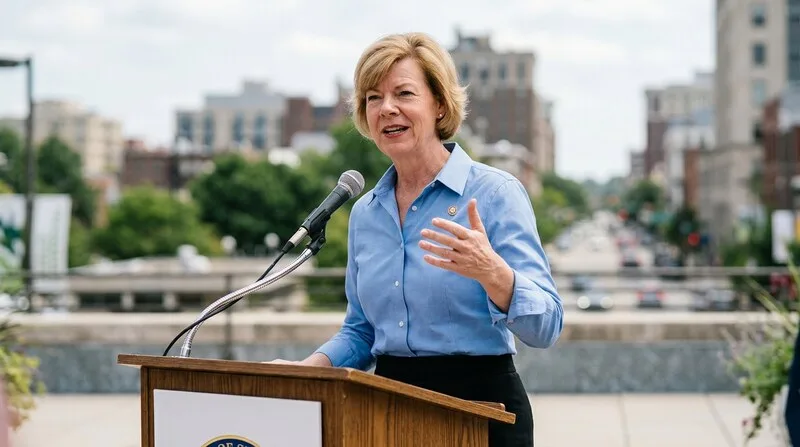
- Tammy Baldwin (D-WI) lost her re-election bid in 2024 to Republican Eric Hovde by 2 points, ending her 26-year congressional career (House + Senate) after two Senate terms.
- She was the first openly gay senator elected in US history (2012) and had won re-election in 2018 by 11 points — but Wisconsin's increasingly Republican lean in 2024 proved insurmountable.
- Wisconsin is a true battleground — Trump won the state by 1 point at the presidential level in 2024, and Baldwin lost while Trump simultaneously won, showing the limits of ticket-splitting even for a popular incumbent.
- Baldwin served on the Senate Appropriations and HELP Committees and was known for bipartisan work on manufacturing (Buy American provisions) and healthcare — her centrist approach preserved her Senate seat longer than many expected in a state drifting rightward.
Wisconsin's Senior Senator and a Historic First
Tammy Baldwin's 2012 Senate victory was a landmark in American political history. When she defeated former Governor Tommy Thompson that November, she became the first openly gay person ever elected to the United States Senate. The milestone was significant not only symbolically but politically: Wisconsin had elected a conservative Republican as governor in 2010 (Scott Walker), and Baldwin's statewide win demonstrated that a progressive Democrat could win in a competitive midwestern state that was increasingly contested at the presidential level.
Baldwin's path to the Senate ran through the House, where she served eight terms representing Wisconsin's 2nd congressional district, anchored by Madison. She was the first woman elected to Congress from Wisconsin when she won the seat in 1998, and she compiled a reliably progressive voting record during her House tenure. Healthcare and trade were central to her legislative work even then, setting the priorities that would define her Senate career.
Her Senate record reflects a deliberate effort to pair progressive values with a particular focus on issues resonant with Wisconsin's working-class, manufacturing, and agricultural base. She has been an aggressive critic of pharmaceutical pricing, a consistent advocate for domestic manufacturing through trade policy, and one of the Senate's most active voices on veterans' healthcare. In 2018 she won re-election by roughly 11 points over Republican Leah Vukmir, a margin that reflected both her incumbency advantage and a favorable Democratic environment that cycle. The question heading into 2026 is whether those tailwinds will be present in a state where the political terrain has shifted.
Key Policy Areas
ACA Champion and Drug Pricing Hawk
Baldwin has been one of the Senate's most consistent defenders of the Affordable Care Act and an aggressive legislator on prescription drug pricing. She co-authored legislation targeting insulin price caps and worked across the aisle on drug importation proposals. Healthcare has been her most effective political issue, allowing her to connect progressive policy priorities to the concrete economic concerns of Wisconsin voters.
Worker-First Trade Policy
Baldwin has a notably heterodox record on trade compared to most Senate Democrats, consistently prioritizing manufacturing worker protections over free-trade agreements. She opposed the Trans-Pacific Partnership and has supported Buy America provisions and domestic content requirements. This positioning gives her crossover appeal in parts of Wisconsin where the manufacturing economy has been reshaped by trade flows, though it has occasionally put her at odds with business-aligned Democrats.
VA Reform and Veterans Care
Baldwin has made veterans' healthcare a signature issue, working on VA accountability legislation and advocating for improved mental health services for veterans. Her bipartisan work on veterans' issues has allowed her to build relationships across the aisle and demonstrate effectiveness to a constituency that often leans Republican. She sits on the Senate Appropriations Committee, where she can direct resources toward veterans' programs in Wisconsin.
Electoral History
| Year | Race | Result | Margin |
|---|---|---|---|
| 2026 | Wisconsin Senate (re-election) | Up for election | TBD |
| 2018 | Wisconsin Senate (re-election) | Baldwin 55.4% — Leah Vukmir (R) 44.6% | D +10.8 |
| 2012 | Wisconsin Senate (open seat) | Baldwin 51.4% — Tommy Thompson (R) 45.9% | D +5.5 |
| 2010 | WI-02 House (re-election) | Baldwin 62.1% — Chad Lee (R) 33.7% | D +28.4 |
The 2026 Map and Wisconsin's Swing State Identity
Wisconsin is structurally one of the most competitive states in the country, and its recent trajectory has trended toward Republicans at the presidential level. Donald Trump carried Wisconsin in 2016, Joe Biden carried it by less than one percentage point in 2020, and Trump carried it again in 2024. The state's political geography — a heavily Democratic Madison and Milwaukee metro area surrounded by large rural and small-city areas that have shifted dramatically toward Republicans over the past decade — creates a structural challenge for Democratic statewide candidates who cannot simply run up margins in their base.
Baldwin's 2018 re-election came in a wave Democratic environment against a Republican opponent, Leah Vukmir, who struggled to consolidate the party base. The 2026 environment is harder to predict, but Republicans will almost certainly recruit a stronger challenger and invest significantly in the race. Baldwin's biggest asset is her incumbency and the personal brand she has built over two-plus decades of Wisconsin politics. Her heterodox trade positions and focus on manufacturing and healthcare give her crossover appeal that pure progressives in Wisconsin would lack.
The race is currently rated as a toss-up or lean-Republican by most forecasters. A Republican pickup here would be one of the cleaner paths to expanding their Senate majority; a Baldwin hold would be a signal that Democrats can still win statewide in states Trump carries at the presidential level.
Approval Rating Trend
| Period | Approve | Disapprove | Notes |
|---|---|---|---|
| Early 2026 | 42% | 45% | Tight as 2026 race approaches; WI trending R |
| Late 2025 | 44% | 43% | Roughly even; incumbency holds in off-year |
| Mid 2025 | 45% | 42% | Modest positive approval; healthcare message cutting |
| Late 2024 | 46% | 41% | Post-election period; WI went for Trump at pres. level |
| Mid 2023 | 47% | 39% | Mid-term period; solid marks for bipartisan work |