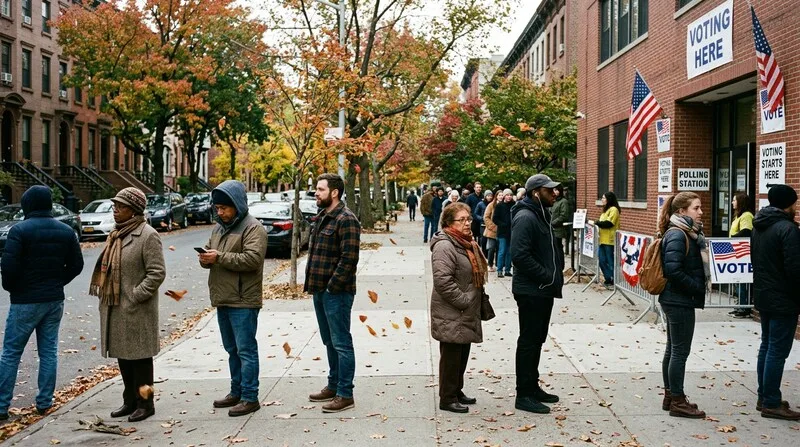
2026 Midterm Elections: The Democratic Wave Forecast
Democrats need only 5 net House seats to flip the majority. With Trump\'s approval at 43%, the generic ballot at D+6, consumer confidence at 57, and Medicaid cuts polling at -59 net, every major historical model points to a Democratic gain of 20–35+ House seats and a Senate toss-up leaning Democratic. The environment as of spring 2026 more closely resembles 2006 and 2018 than any Republican-favorable cycle.
Current Environment: The Three Indicators
Presidential Approval: 43%
Trump's approval has averaged 43–44% since January 2026, damaged by tariff impacts, DOGE-related cuts, and Medicaid reduction proposals in the reconciliation bill. No president below roughly 46–47% has avoided meaningful House seat losses in a midterm. At 43%, historical models (Abramowitz, Jacobson) predict Republican losses of 20–35 House seats. The floor is not visible: if approval drops to 38–40% by November, projections climb to D+40+.
Generic Ballot: D+6
The generic congressional ballot — which party's candidate would you vote for in your House district — has consistently shown D+4 to D+8 in spring 2026 polling. The average sits near D+6. Historical translation: D+6 on election day corresponds to approximately D+25 House seats, based on the 2018 (D+8.6 actual, D+41) and 2006 (D+7.9, D+31) relationships. The generic ballot tends to narrow slightly toward election day, making D+4 to D+5 a realistic floor for final-day expectations.
Consumer Confidence: 57
The Conference Board consumer confidence index fell to 57 in spring 2026 on tariff uncertainty, Q1 GDP at +2.0% but PCE inflation surging to 4.5%, raising stagflation concerns. Consumer confidence below 80 has historically correlated with significant incumbent-party losses in midterms. The 2010 wave year saw consumer confidence around 50–54; 2006 saw it around 105. The current reading of 57 is far below the "safe" range for Republicans and is historically consistent with D+20 to D+35 seat swings.

Chamber-by-Chamber Projections
| Chamber | Current Composition | Seats Democrats Need | Central Projection | Range | Rating |
|---|---|---|---|---|---|
| House of Representatives | R 220, D 215 | 5 net pickups | D+25 seats | D+15 to D+40 | Lean Democratic majority |
| Senate | R 53, D 47 | 4 net pickups | D+3 seats | D+1 to D+6 | Toss-up leaning D |
Key House Races to Watch
| District | Incumbent | 2024 Trump margin | Current Rating | Why it matters |
|---|---|---|---|---|
| NY-17 | Mike Lawler (R) | Biden +2 (2020) | Lean D | Lawler won in 2022 wave; district is D-leaning; top D target |
| CA-27 | Mike Garcia (R) | Trump +3 | Toss-up | Garcia has won 3 close races; Biden district that narrowly flipped R in 2024 |
| NE-02 | Don Bacon (R, retired) | Trump +2 | Toss-up | Open seat; congressional district that split its EV in 2020/2024 |
| VA-02 | Jen Kiggans (R) | Trump +4 | Toss-up | Military-heavy district; DOGE cuts and VA budget cuts resonating negatively |
| MI-07 | Tom Barrett (R) | Trump +3 | Lean D | Suburban Lansing; new district drawn for D lean that R won narrowly in 2024 |
| TX-28 | Jay Obernolte (R) | Trump +5 | Toss-up | Competitive; Hispanic shift that helped R in 2024 may reverse on tariff costs |
Key Senate Races 2026
| State | Incumbent / Candidate | Party | 2024 Presidential | Rating |
|---|---|---|---|---|
| Maine | Susan Collins | R (inc.) | Harris +7 | Lean D flip |
| Pennsylvania | Open (McCormick retiring) | R (open) | Trump +2 | Toss-up |
| North Carolina | Thom Tillis | R (inc.) | Trump +3 | Toss-up |
| Florida | Rick Scott | R (inc.) | Trump +13 | Safe R |
| Texas | John Cornyn | R (inc.) | Trump +14 | Safe R |
| Michigan | Open (Peters retiring) | D (open) | Trump +1.4 | Toss-up lean D |
| Georgia | Jon Ossoff | D (inc.) | Trump +12 | Lean R |
Historical Model: Approval vs. House Seat Changes
| Year | President | Approval (Election Day) | House Seat Change | Generic Ballot | Consumer Confidence |
|---|---|---|---|---|---|
| 2002 | Bush (R) | 65% | R+8 | R+4.6 | ~95 |
| 2006 | Bush (R) | 37% | D+31 | D+7.9 | ~105 |
| 2010 | Obama (D) | 44% | R+63 | R+7.8 | ~54 |
| 2014 | Obama (D) | 42% | R+13 | R+2.4 | ~92 |
| 2018 | Trump (R) | 41% | D+41 | D+8.6 | ~136 |
| 2022 | Biden (D) | 43% | R+9 | R+3.0 | ~102 |
| 2026 (proj.) | Trump (R) | 43% | D+20 to D+35? | D+6 | 57 |
The 2022 result (R+9 despite Biden's 43% approval) is frequently cited as the counterfactual for 2026. The key difference: in 2022, the generic ballot was R+3 and consumer confidence was ~102. In 2026, the generic ballot is D+6 and consumer confidence is 57. A 9-point generic ballot swing between cycles is the largest in recent history, and the consumer confidence drop from 102 to 57 rivals the 2010 environment. Both indicators point decisively toward a Democratic gain significantly larger than 2022's Republican gain.
Competitive Seat Summary (Cook / Sabato Methodology)
Even without a wave — if only Toss-up seats go to Democrats — Democrats would net approximately 5 seats and barely flip the House. A moderate wave (D+6 generic ballot sustained) would convert most Lean R seats to Democratic pickups as well, producing D+20 to D+25. A strong wave (D+8+) would put Likely R seats in play and push projections toward D+35+.
The Issues Driving 2026
Medicaid Cuts (-59 net)
The 2025–2026 Republican reconciliation bill included cuts to Medicaid of $880 billion over 10 years. Polling shows these cuts are opposed by 70–75% of voters, with net favorability around -59 nationally. Critically, the cuts poll worse than ACA repeal did in 2017–2018 (-25 to -30 net), providing Democrats a sharper, more concrete attack than healthcare offered in 2018. The Medicaid issue is particularly potent in suburban and rural districts where Medicaid expansion is popular.
Tariffs and Trade War
The 2025 tariff escalation — with tariffs on Chinese goods reaching 145% and broad 10% universal tariffs — has produced visible price increases on consumer goods, reduced import volumes, and Q1 2026 GDP of +2.0% masked by PCE inflation hitting 4.5% — a stagflation pattern that historically unnerves voters. Polling shows 58–64% of voters oppose the tariff policy. The economic pain is most visible in agricultural states (soybean/corn export disruption), manufacturing districts (steel input costs), and retail-heavy suburban districts, all of which overlap with competitive House races.
DOGE Cuts and Federal Services
The Department of Government Efficiency's federal workforce reductions — approximately 200,000 federal jobs eliminated or restructured — generated significant local economic disruption in areas with high federal employment concentration (Northern Virginia, Maryland suburbs, parts of the Mountain West). Cuts to VA services and Social Security Administration staffing resonated negatively with military-adjacent and senior-heavy districts. DOGE polling shows net -25 to -35 in most battleground-district surveys.