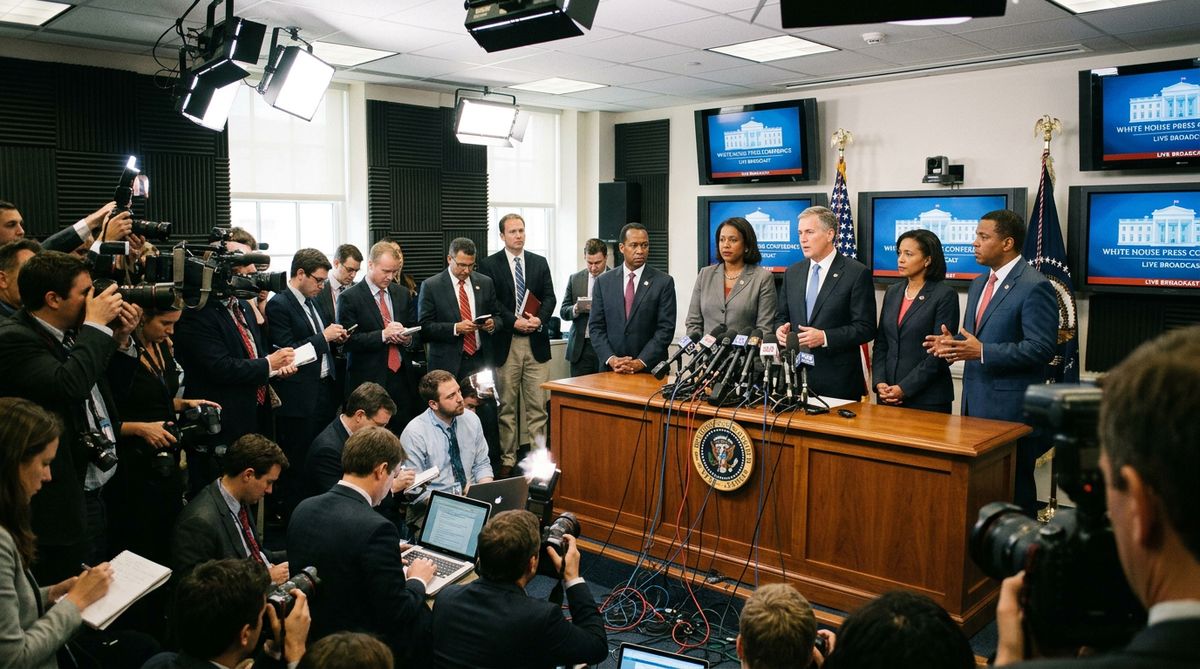
The White House
Executive branch leadership
Donald Trump
The 47th President of the United States, serving his second non-consecutive term after defeating Kamala Harris in November 2024. Trump's second term is reshaping federal government with sweeping tariff policy, federal workforce reductions and immigration enforcement on a historic scale.
Full profile →JD Vance
The 50th Vice President, former Ohio senator and author of "Hillbilly Elegy." A one-time Trump critic turned loyal ally, Vance is widely regarded as the leading contender for the 2028 Republican presidential nomination. His foreign policy skepticism has made him a distinct voice in the administration.
Full profile →Trump Cabinet 2025
The Trump second-term cabinet is marked by loyalists and non-traditional picks, including Elon Musk leading the Department of Government Efficiency (DOGE), Pete Hegseth at Defense and Marco Rubio as Secretary of State. Several nominees faced turbulent confirmation battles.
Tulsi Gabbard
Former Hawaii congresswoman (2013–2021), 2020 presidential candidate, and the first Hindu and first American Samoan elected to Congress. She left the Democratic Party in October 2022, endorsed Trump in 2024, and was confirmed as Director of National Intelligence in January 2025 — the head of the 18-agency US Intelligence Community.
Full profile →Congressional Leaders
House and Senate leadership on both sides
Mike Johnson
Louisiana congressman who became the 56th Speaker of the House in October 2023 after the chaotic removal of Kevin McCarthy. A deeply conservative Christian and constitutional lawyer, Johnson must manage a razor-thin Republican majority heading into the 2026 cycle.
Full profile →Hakeem Jeffries
Brooklyn congressman and the first Black legislator to lead a major party in either chamber of Congress. Jeffries has unified House Democrats and is widely seen as the party's future. He needs only 5 net seat gains to reclaim the Speaker's gavel in 2027.
Full profile →Chuck Schumer
New York's senior senator and Senate Minority Leader after four years as Majority Leader. Schumer shepherded landmark legislation including the Inflation Reduction Act and CHIPS Act through a 50–50 Senate, but now leads the minority with 47 seats against a 53-seat Republican majority.
Full profile →Mitch McConnell
The longest-serving Senate party leader in American history, McConnell stepped down from leadership in January 2025 but remains a Kentucky senator until 2027. His legacy includes reshaping the federal judiciary with three Supreme Court appointments under Trump.
Full profile →Kamala Harris
The first woman, first Black and first South Asian Vice President, Harris became the 2024 Democratic presidential nominee after Biden's July withdrawal. She lost a close race to Trump and is now out of office, with her future role in the Democratic Party still evolving.
Full profile →Senate Balance 2025
Republicans hold 53 Senate seats to Democrats' 47 (including two independents who caucus with Democrats). John Thune of South Dakota succeeded McConnell as Republican Senate Majority Leader, setting the agenda for the 119th Congress.
Alexandria Ocasio-Cortez (AOC)
The youngest woman ever elected to Congress, AOC beat a 10-term incumbent in the 2018 primary and has become the face of the progressive left. Co-author of the Green New Deal, she raised over $10 million in the 2024 cycle — more than most senators — and channeled millions into competitive House races.
Full profile →Nancy Pelosi
The first woman Speaker of the House, serving two non-consecutive speakerships (2007–2011 and 2019–2023). She passed the Affordable Care Act in 2010 and presided over both Trump impeachments. San Francisco congresswoman since 1987 and the most prolific fundraiser in Democratic Party history. Stepped down from leadership in January 2023.
Full profile →Bernie Sanders
The longest-serving independent in congressional history, Sanders ran for president in 2016 and 2020, winning 23 states and revolutionizing progressive small-dollar fundraising. He announced he will not seek re-election in 2026, creating Vermont's first open Senate seat in nearly two decades.
Full profile →Elizabeth Warren
Harvard Law professor turned senator, Warren conceived the Consumer Financial Protection Bureau after the 2008 financial crisis and has been the progressive movement's most detail-oriented Senate voice since 2013. Re-elected in 2024, she is the architect of the wealth tax and Medicare for All transition proposals that define the Democratic left.
Full profile →Gavin Newsom
California's two-term governor, former San Francisco mayor, and the Democratic Party's most prominent 2028 presidential frontrunner. Term-limited in 2027, Newsom has built one of the deepest national donor networks in the party while enacting the nation's most aggressive climate and gun control legislation from Sacramento.
Full profile →Pete Buttigieg
Harvard grad, Rhodes Scholar, former South Bend mayor, and Transportation Secretary 2021–2025. Buttigieg won the 2020 Iowa caucus as the first openly gay candidate to win a presidential primary contest. Now out of government and widely viewed as a leading 2028 contender with strong appeal among suburban moderate Democrats.
Full profile →Amy Klobuchar
Minnesota's four-term senator and the Senate's leading antitrust voice. Former Hennepin County prosecutor who flipped a Republican Senate seat in 2006, ran for president in 2020 before endorsing Biden at a pivotal pre-Super Tuesday moment, and has championed antitrust action against Big Tech in high-profile Judiciary Committee hearings.
Full profile →Tim Kaine
Virginia senator since 2013, former Governor (2006–2010) and Hillary Clinton's VP pick in 2016. A fluent Spanish speaker who learned the language as a Jesuit volunteer in Honduras, Kaine is a Catholic moderate known for his advocacy on war powers reform and Senate Foreign Relations work. Re-elected in 2018 by 16 points; next election 2030.
Full profile →Current Senate Democrats
Key Democratic senators and a notable former senator from the 2020s
John Fetterman
Pennsylvania senator since 2023, former mayor of Braddock and Lieutenant Governor. Won a dramatic 2022 race against Mehmet Oz while recovering from a stroke he suffered three days before the Democratic primary. Known for his distinctive 6’8” appearance and blue-collar political identity, he has become one of the Senate’s more moderate Democrats on immigration and Israel.
Full profile →Kirsten Gillibrand
New York senator since 2009, appointed to replace Hillary Clinton. Led the successful push to repeal Don’t Ask, Don’t Tell in 2010 and spent a decade fighting to reform military sexual assault prosecution — achieved in 2021. Re-elected in 2012, 2018, and 2024; ran unsuccessfully for president in 2019.
Full profile →John Hickenlooper
Colorado senator since 2021, former two-term governor and Denver mayor. Won his 2020 race by 9 points against incumbent Cory Gardner. A geologist-turned-craft-brewer-turned-politician, he is one of the Senate’s moderate Democrats, focusing on climate, Western water rights, and technology policy. Ran briefly for president in 2019.
Full profile →Bob Menendez
New Jersey senator 2006–2024. Convicted on all 16 federal bribery counts in July 2024 after prosecutors found $480,000 in cash and $150,000+ in gold bars in his home, given by businessmen in exchange for using his Senate office to benefit them and to act as an agent for Egypt and Qatar. Resigned August 2024. Replaced by Andy Kim (D).
Full profile →Notable Republicans
2028 contenders and key figures shaping the post-Trump GOP
Ron DeSantis
Florida's two-term governor who was re-elected by 19 points in 2022, ran for president in 2024 but dropped out early and endorsed Trump. Term-limited in 2026, he is widely expected to run for president in 2028. His model of cultural conservatism paired with fiscal discipline has influenced Republicans nationwide.
Full profile →Nikki Haley
The first Indian-American governor and the last major Trump challenger in the 2024 primary. She stayed in the race longest, consistently pulling 40%+ of Republican primary voters — demonstrating a non-MAGA lane exists in the GOP. Now in political limbo as she navigates toward a likely 2028 run.
Full profile →Marco Rubio
Florida's former senator, 2016 presidential candidate, and now Trump's Secretary of State. His career arc — from Gang of Eight immigration reformer to MAGA-aligned loyalist — mirrors the transformation of the broader Republican Party over the past decade. Confirmed January 2025.
Full profile →Josh Hawley
Missouri's Yale Law senator known for raising his fist to the January 6th crowd, his anti-Big Tech platform, and a populist economic agenda focused on working-class men. One of the few Republicans to support aspects of union legislation, he combines cultural conservatism with a coherent critique of corporate globalism. A leading 2028 contender.
Full profile →Ted Cruz
Princeton and Harvard Law graduate, former Supreme Court clerk and Texas Solicitor General, Cruz is one of the Senate's most formidable constitutional lawyers and a MAGA-aligned hardliner since 2016. The last major rival standing against Trump in the 2016 primary, he objected to the 2020 election certification on January 6 and won re-election in Texas in 2024 by 5.2 points.
Full profile →Chris Christie
Former New Jersey governor who won re-election in 2013 by 22 points in a blue state, and the only major Republican candidate in the 2024 primary to directly and consistently attack Trump as unfit for office. Dropped out before New Hampshire but positioned himself as the "I told you so" voice of the anti-Trump Republican wing.
Full profile →Rand Paul
Kentucky's libertarian-leaning senator and son of Ron Paul, in office since 2011. Known for his nearly 13-hour drone strike filibuster, blocking Ukraine aid packages, viral Fauci hearing clashes, and consistent Fourth Amendment advocacy. The Senate's most prominent non-interventionist voice within the Republican Party.
Full profile →John McCain (1936–2018)
Navy pilot held as a POW at the Hanoi Hilton for five and a half years, Arizona senator from 1987 to 2018, and the 2008 Republican presidential nominee. His dramatic thumbs-down vote preserved the ACA in July 2017. His feud with Trump — and Trump’s attacks on him as a POW — defined the Republican Party’s Trump-era transformation.
Full profile →Sarah Palin
Alaska’s youngest governor and first woman in that role, selected by John McCain as his VP running mate in 2008. Her anti-elite, media-hostile populism introduced the political template that Trump later perfected. A Tea Party figurehead who endorsed Trump in January 2016, she lost two congressional races in Alaska in 2022 under the state’s ranked-choice system.
Full profile →Newt Gingrich
Architect of the 1994 Republican Revolution, which won the House majority for the first time in 40 years. Speaker of the House 1995–1999, co-author of the Contract with America, and the man who negotiated the first balanced federal budgets since the 1920s. His combative, nationalized politics is widely seen as a founding moment of modern partisan polarization — and as a direct precursor to the Trump era.
Full profile →2012 Republican Ticket
Romney and Ryan — the last standard-bearers of pre-Trump Republicanism
Mitt Romney
Massachusetts Governor, co-founder of Bain Capital, 2012 presidential nominee who lost to Obama 206–332. As Utah Senator (2019–2025), he became the first senator to vote to convict a president of his own party — casting guilty votes in both Trump impeachment trials. Retired from the Senate in January 2025 with a warning about democratic backsliding.
Full profile →Paul Ryan
Wisconsin congressman (1999–2019), the Republican Party’s chief fiscal policy intellectual, and Speaker of the House from 2015 to 2019. Author of the Ryan Budgets proposing Medicare restructuring, he passed the Tax Cuts and Jobs Act in 2017 but failed to repeal the ACA. Represents a policy-focused conservatism that the post-2016 GOP largely abandoned.
Full profile →Notable Senators: Past & Present
Key figures who shaped or are shaping the Senate in the 2020s
Tim Scott
The first Black Republican senator from the South since Reconstruction, Scott has served South Carolina since 2013 and was re-elected in 2022. He ran for president in 2024, endorsing Trump after suspending his campaign. Author of the Opportunity Zones program and an unusual Republican voice on police reform. A potential 2028 contender.
Full profile →Tom Cotton
Harvard Law graduate, Army Ranger, and two-tour Iraq and Afghanistan veteran serving Arkansas since 2015. One of Trump's closest Senate allies and the Senate's most prominent China hawk. Organized the 2015 letter to Iran and wrote the 2020 op-ed calling for military intervention in domestic protests. A leading 2028 presidential prospect.
Full profile →Joe Manchin
West Virginia's senator for 15 years (2010–2025) and the most conservative Democrat in the chamber. He blocked Build Back Better in December 2021 but enabled the Inflation Reduction Act — the largest climate investment in American history. Switched to independent in 2023, declined to run for re-election in 2024. Replaced by Republican Jim Justice in January 2025.
Full profile →Jim Clyburn
Former House Majority Whip and the longest-serving Black member of Congress from South Carolina. A civil rights veteran arrested in 1960s sit-ins, Clyburn's February 2020 endorsement of Joe Biden before the South Carolina primary is widely credited with saving Biden's campaign. His "10/20/30" funding formula for historically impoverished counties is embedded in multiple pieces of federal legislation.
Full profile →Ron Johnson
Wisconsin's three-term Republican senator, first elected in 2010 by defeating three-term incumbent Russ Feingold. One of Trump's closest Senate allies, he survived re-election in 2022 by 1 point in a state where Democrats won other offices by larger margins. Known for his prominent COVID vaccine skepticism, his role in Jan. 6 events, and his consistent opposition to Ukraine aid.
Full profile →Tommy Tuberville
Alabama senator since 2021, former head football coach at Auburn (85–40, 2004 undefeated season) and Texas Tech. Won his 2020 race by 20 points over Democrat Doug Jones. Became nationally known for placing an unprecedented 11-month blanket hold on 400+ military promotions in 2023 to protest Pentagon abortion travel policy. A strong Trump ally; up for re-election in 2026.
Full profile →Sherrod Brown
Ohio's three-term senator (2007–2025), known for an authentic working-class political identity that let him survive in a rightward-trending state long after other Democrats could not. A pre-Trump trade skeptic and consistent union advocate, he lost to Trump-backed Bernie Moreno in 2024 as Ohio drifted out of reach for statewide Democrats. The last of his kind in Ohio for the foreseeable future.
Full profile →Jon Tester
Montana's three-term senator (2007–2025) and the last archetype of the rural Democrat who could hold a Senate seat in a heavily Republican state. A genuine third-generation wheat farmer who lost three fingers in a childhood accident, Tester authored the PACT Act expanding VA burn pit care and survived three competitive elections before losing to Tim Sheehy by 15 points in 2024.
Full profile →Kyrsten Sinema
Arizona's senator 2019–2025 and the pivotal figure — alongside Joe Manchin — who shaped and constrained Biden's domestic agenda. Blocked filibuster reform, killed the original Build Back Better bill's tax provisions, and left the Democratic Party in December 2022. Declined to seek re-election in 2024; replaced by Democrat Ruben Gallego. One of the more enigmatic political figures of the Biden era.
Full profile →2026 Senate Candidates to Watch
Democratic incumbents defending competitive seats in November 2026
Jon Ossoff
Elected in Georgia's January 2021 runoff, Ossoff faces what may be the toughest Senate re-election of the cycle in a state Trump carried in 2024. A former investigative journalist and the youngest senator at the time of his election.
Full profile →Mark Kelly
Retired NASA astronaut and Navy combat pilot who won Arizona's Senate seat in 2020 and held it in 2022. His bipartisan reputation and strong fundraising make him one of the most competitive Democrats in a red-trending battleground state.
Full profile →Jacky Rosen
Nevada's junior senator, re-elected in 2024, faces the 2026 cycle in a state that has trended toward Republicans. A former computer programmer and synagogue president, Rosen focuses on bipartisan tech policy, veterans affairs and Israel security.
Full profile →Gary Peters
Michigan's senior senator and former chair of the Democratic Senatorial Campaign Committee. Peters won re-election in 2020 by a comfortable margin, but Michigan has trended Republican in recent cycles. His seat is rated competitive heading into 2026.
Full profile →Raphael Warnock
Senior pastor of Ebenezer Baptist Church (MLK's church) and Georgia's senator since his landmark January 2021 runoff. Re-elected in December 2022 by 2.8 points over Herschel Walker. His 2026 race is one of the most expensive and closely watched in the country as Republicans target the seat in a state that voted for Trump in 2024.
Full profile →Rising Stars — 2028 Watch List
Democratic governors building national profiles ahead of the next presidential cycle
Gretchen Whitmer
Michigan's two-term governor and one of the most prominent Democrats in America. Known for pragmatic governance and a failed assassination plot that raised her national profile, Whitmer is widely expected to be a leading 2028 presidential contender. Her Michigan coalition could be a template for Democratic recovery in the Rust Belt.
Full profile →Josh Shapiro
Pennsylvania's governor and one of the most effective Democratic communicators in the country. Shapiro won in 2022 by 15 points in a critical swing state and was seriously vetted as a VP candidate in 2024 before Harris selected Tim Walz. His ability to win working-class voters makes him a serious 2028 prospect.
Full profile →Wes Moore
Army veteran, Rhodes Scholar, bestselling author and Maryland's first Black governor. Won in 2022 by 32 points — the largest margin in Maryland gubernatorial history. In office since January 2023, focused on economic opportunity and workforce development. A compelling potential 2028 contender with an extraordinary personal biography.
Full profile →JB Pritzker
Billionaire Hyatt heir and two-term Illinois governor who signed abortion protections before Dobbs, legalized marijuana, ended cash bail, and raised the minimum wage to $15. The most openly ambitious 2028 contender outside of Newsom, with the personal wealth to self-fund a presidential campaign at a scale no rival can match.
Full profile →Cory Booker
Yale, Oxford Rhodes Scholar, Yale Law, Stanford Law — former Newark mayor turned senator and 2020 presidential candidate. Set the Senate record in April 2025 with a 25-hour floor speech protesting Trump spending cuts, breaking Strom Thurmond's 1957 record. A criminal justice reformer who co-authored the First Step Act with the Trump White House.
Full profile →Dave McCormick
Pennsylvania's junior senator, elected in 2024 after defeating incumbent Bob Casey in one of the most expensive Senate races in history. A former hedge fund CEO and Army veteran, McCormick is a key figure in a state that could determine both the 2026 Senate map and the 2028 presidential race.
Full profile →Stacey Abrams
Two-time Georgia governor candidate (2018, 2022), founder of Fair Fight Action, and the organizer most credited with building the voter registration infrastructure that flipped Georgia for Biden in 2020 and produced the Senate majority via the January 2021 runoffs. The first Black woman nominated for governor by a major party in American history; a potential 2028 contender.
Full profile →Historical Candidates
McGovern and Dole — major-party nominees whose defeats shaped the parties they left behind
George McGovern (1922–2012)
WWII bomber pilot (35 missions, Distinguished Flying Cross) and South Dakota Senator who became the 1972 Democratic presidential nominee on an anti-Vietnam War platform. Lost to Nixon 520–17 in the Electoral College, carrying only Massachusetts. His defeat became the defining cautionary tale of Democratic electability for two generations.
Full profile →Bob Dole (1923–2021)
WWII veteran who lost the use of his right arm in Italy, Kansas Senator for 27 years, and Senate Majority Leader. The 1996 Republican presidential nominee who lost to Clinton. Principal Senate champion of the Americans with Disabilities Act (1990) and co-author (with McGovern) of the international food aid program bearing both their names.
Full profile →20th Century Presidents
Wilson to Eisenhower — WWI, New Deal, WWII and Cold War foundations
Woodrow Wilson (1856–1924)
Led the US through WWI, proposed the League of Nations, and created the Federal Reserve. Won the most lopsided electoral victory (435 EV) of any president with under 42% of the popular vote. His progressive legacy is marred by his systematic segregation of the federal civil service.
Full profile →Franklin D. Roosevelt (1882–1945)
The only president elected four times, FDR guided the US through the Great Depression (New Deal: Social Security, FDIC, WPA) and World War II (Lend-Lease, D-Day planning, Yalta). He died in office on April 12, 1945 — three weeks before Germany’s surrender. His presidency permanently transformed the role of the federal government in American life.
Full profile →Harry S. Truman (1884–1972)
Inherited the presidency on FDR’s death, dropped the atomic bombs ending WWII, and built the Cold War order: Marshall Plan, NATO, Truman Doctrine. His 1948 “Dewey Defeats Truman” upset is the most famous polling failure in history. The Korean War drove his approval to 22% — then the lowest ever recorded.
Full profile →Dwight D. Eisenhower (1890–1969)
WWII Supreme Commander who led D-Day and accepted Germany’s surrender, then won the presidency in 1952 and 1956 landslides. Built the Interstate Highway System, created NASA, enforced school desegregation at Little Rock. His farewell address warning of the “military-industrial complex” (1961) is among the most quoted in presidential history.
Full profile →Historical Presidents
Nixon, Ford, Carter and Bush 41 — from Watergate to the Cold War's end
Richard Nixon (1913–1994)
37th President (1969–1974), Nixon opened China, created the EPA, and signed the Paris Peace Accords ending US involvement in Vietnam. He won re-election in 1972 by a 520–17 Electoral College landslide. The Watergate cover-up consumed his second term; he resigned on August 9, 1974 — the only president in American history ever to do so.
Full profile →Gerald Ford (1913–2006)
The only president never elected president or vice president, Ford took office in August 1974 after Nixon’s resignation. His pardon of Nixon — which he called necessary to end “our long national nightmare” — cost him the 1976 election to Carter. He is now widely regarded as having made a courageous decision that prioritized national recovery over political survival.
Full profile →Jimmy Carter (1924–2024)
Carter brokered the 1978 Camp David Accords — the first Israel–Arab peace agreement — but was undone by the Iran hostage crisis (444 days) and 13% inflation, losing to Reagan in a 489–49 Electoral College landslide. His 44-year post-presidency — Carter Center, Habitat for Humanity, Nobel Peace Prize 2002 — is widely considered the greatest in American history. Died December 29, 2024, at age 100.
Full profile →George H.W. Bush (1924–2018)
Bush 41 managed the end of the Cold War, German reunification, and the Soviet collapse without a major conflict — then assembled a 35-nation coalition to liberate Kuwait in Operation Desert Storm (1991). His approval reached 89%, the highest in Gallup history. He lost re-election to Clinton in 1992 after breaking his “read my lips, no new taxes” pledge amid recession and Ross Perot’s 19% independent vote.
Full profile →Former Presidents & Vice Presidents
Historical figures whose legacies shape today's political landscape
Barack Obama
The first African American president, Obama served two terms (2009–2017) defined by the Affordable Care Act, the killing of Osama bin Laden, and the economic recovery from the 2008 financial crisis. He left office with a 59% approval rating and remains one of the most influential figures in the Democratic Party.
Full profile →George W. Bush
Bush's presidency (2001–2009) was defined by September 11, the Afghanistan and Iraq Wars, and the 2008 financial crisis. His approval rating swung from 90% (highest in Gallup history, post-9/11) to 22% at departure. He represents a Republican tradition of internationalism and compassionate conservatism that Trump-era politics has largely replaced.
Full profile →Mike Pence
Trump's Vice President (2017–2021) and Indiana Governor before that, Pence is defined by one decision: on January 6, 2021, he certified Biden's Electoral College victory despite intense presidential pressure to refuse. Trump supporters chanted “Hang Mike Pence.” His 2024 presidential campaign collapsed before Iowa. He endorsed no one in the general election.
Full profile →Hillary Clinton
The first woman nominated for president by a major American political party, Clinton served as Secretary of State (2009–2013), US Senator from New York (2001–2009), and First Lady during Bill Clinton’s presidency. She won the 2016 popular vote by 2.87 million votes but lost the Electoral College 232–306 to Donald Trump.
Full profile →Joe Biden
Biden served one term (2021–2025) defined by the American Rescue Plan, the Bipartisan Infrastructure Law, NATO unity on Ukraine, and the June 2024 debate performance that ended his re-election campaign. He left office at 82 — the oldest president in American history — with a 38% approval rating.
Full profile →Bill Clinton
Clinton’s presidency (1993–2001) produced the longest peacetime economic expansion in modern American history, the first budget surplus since 1969, and 22 million jobs. He was impeached by the House on perjury and obstruction charges related to the Lewinsky affair and acquitted by the Senate — leaving office with 65% approval.
Full profile →Al Gore
VP under Bill Clinton (1993–2001), Gore won the 2000 popular vote by 540,000 votes but lost the presidency by 537 Florida votes and a 5–4 Supreme Court ruling. Post-2000, he became the world's most prominent climate activist: “An Inconvenient Truth” (2006) and the Nobel Peace Prize 2007 redefined his legacy.
Full profile →Dick Cheney
Widely regarded as the most powerful VP in American history, Cheney (2001–2009) was the principal architect of the Iraq War, the post-9/11 enhanced interrogation program, and the Bush administration's expansive national security state. He suffered five heart attacks and received a heart transplant in 2012. He voted for Biden in 2020 and endorsed Harris in 2024.
Full profile →Ronald Reagan (1911–2004)
The 40th President (1981–1989) cut the top income tax rate from 70% to 28%, built the economic boom that ended the Carter-era stagflation, and pursued a Cold War strategy that contributed to the Soviet Union’s collapse. Won 49 states in 1984 — the largest Electoral College margin of the modern era. The Iran-Contra affair and the tripling of the national debt are the major shadows on his legacy.
Full profile →Lyndon B. Johnson (1908–1973)
LBJ took office after Kennedy’s assassination and passed the Civil Rights Act, Voting Rights Act, Medicare, Medicaid, and the full Great Society program — the most consequential domestic agenda since the New Deal. He won 44 states in 1964. Vietnam destroyed his presidency: he escalated to 535,000 troops and declined to run for re-election in 1968 with 35% approval.
Full profile →John F. Kennedy (1917–1963)
The first Catholic president and youngest elected, JFK won the 1960 election by 112,827 popular votes — the narrowest margin of the twentieth century. He navigated the Cuban Missile Crisis (the closest to nuclear war in history) without a shot fired, launched the Apollo program, and proposed the Civil Rights Act. Assassinated in Dallas on November 22, 1963, after 1,036 days in office. Approval averaged 70%.
Full profile →1980s & Early 2000s Presidential Nominees
Democratic nominees and candidates who shaped the modern party — from the Mondale landslide to Kerry’s Swift Boat campaign
Walter Mondale (1928–2021)
Vice President under Jimmy Carter and 1984 Democratic nominee who lost 49 states to Ronald Reagan. His convention pledge — “Mr. Reagan will raise taxes, and so will I. He won’t tell you. I just did.” — became the defining moment of political honesty meeting electoral disaster. He redefined the vice presidency as a genuine governing partnership.
Full profile →Gary Hart
Colorado senator and defense intellectual who nearly beat Mondale in 1984 and was the clear 1988 frontrunner until the Donna Rice “Monkey Business” scandal ended his campaign in May 1987. His fall marked the moment press coverage permanently shifted to include private conduct — and he later co-authored the national security report that predicted 9/11.
Full profile →Michael Dukakis
Massachusetts governor and architect of the “Massachusetts Miracle” who squandered a 17-point post-convention lead, losing 111–426 to George H.W. Bush. The Willie Horton ads, the tank photo op, and his eerily calm death penalty debate answer are studied in every campaign management course as cautionary lessons in negative advertising and political vulnerability.
Full profile →John Kerry
Vietnam War hero turned anti-war activist, Massachusetts senator for 28 years, and 2004 nominee who lost 251–286 to Bush. The Swift Boat Veterans campaign gave the language a new verb. As Secretary of State 2013–2017, he negotiated the Iran nuclear deal and the Paris climate agreement — a second legacy that largely eclipsed the 2004 defeat.
Full profile →John Edwards
North Carolina senator who ran on the “Two Americas” populist message, was Kerry’s 2004 VP pick, and was a leading 2008 contender before an affair with campaign filmmaker Rielle Hunter — while his wife Elizabeth was fighting cancer — destroyed his career. Indicted on campaign finance charges in 2011; not convicted.
Full profile →Frequently Asked Questions
Who are the most important US politicians in 2026?
The key figures shaping 2026 are President Donald Trump and Vice President JD Vance in the executive branch, House Speaker Mike Johnson and Minority Leader Hakeem Jeffries in the House, and Senate Minority Leader Chuck Schumer on the Democratic side. At the state level, governors Gretchen Whitmer and Josh Shapiro are the most prominent Democratic voices ahead of the 2028 cycle.
Which Senate seats are competitive in 2026?
The most competitive Senate races in 2026 involve Democratic incumbents defending seats in Trump-carried or lean-Republican states. Georgia (Jon Ossoff), Arizona (Mark Kelly), Nevada (Jacky Rosen) and Michigan (Gary Peters) are the top-tier battlegrounds. New Hampshire, where Jeanne Shaheen is not seeking re-election, is also rated highly competitive.
Who leads the Democratic Party right now?
There is no single national leader of the Democratic Party. Hakeem Jeffries leads House Democrats, Chuck Schumer leads Senate Democrats. At the national level, the party is in a period of transition and internal debate about its future direction, with governors like Gretchen Whitmer and Josh Shapiro increasingly filling the leadership vacuum.