Biography
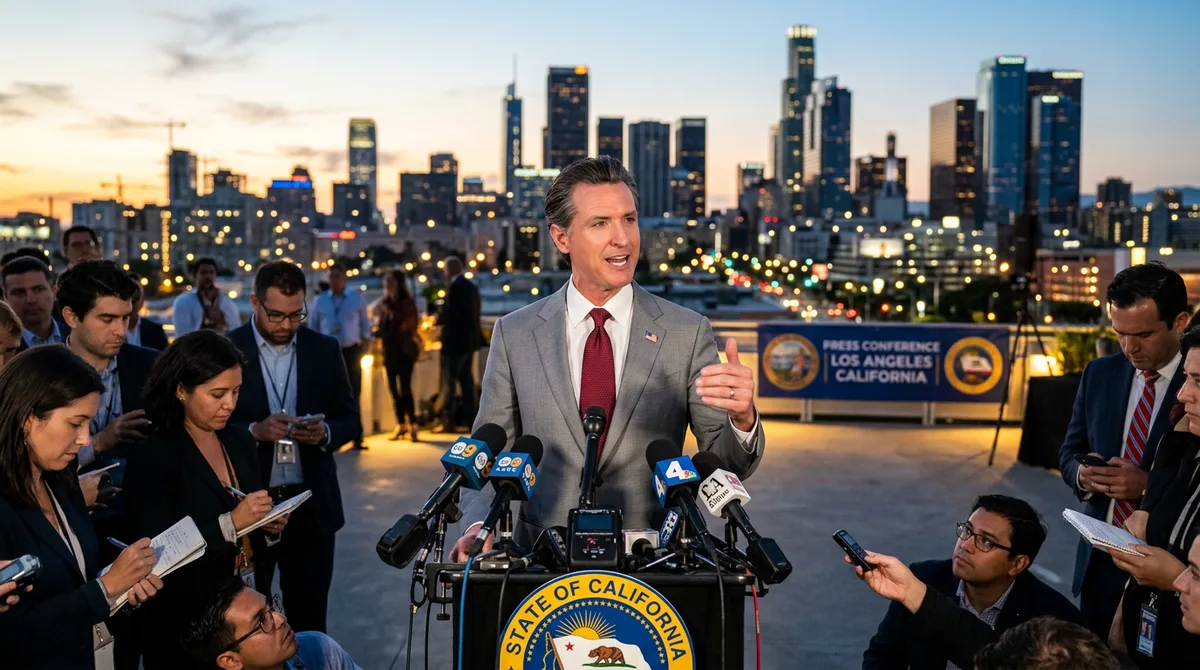
Gavin Christopher Newsom was born on October 10, 1967, in San Francisco, California. He entered politics as a member of the San Francisco Board of Supervisors in 1997, later winning election as Mayor of San Francisco in 2003 and serving until 2011. As mayor, he made national headlines in February 2004 by ordering the city to issue marriage licenses to same-sex couples — making San Francisco the first major American city to do so, months before any court ruling required it. He won re-election as mayor in 2007 by a 73-point margin. He served as California Lieutenant Governor from 2011 to 2019.
Newsom was elected California Governor in November 2018, defeating Republican John Cox by 23 percentage points. His first term was defined by the COVID-19 pandemic response, a series of devastating wildfires, and a September 2021 recall election — triggered largely by Republican activists — which he survived with 61.9% of voters opposing his removal. He was re-elected in 2022 by nearly 18 points. His tenure has produced an ambitious progressive policy record: a $15 statewide minimum wage, the nation's most aggressive electric vehicle mandate requiring all new car sales to be zero-emission by 2035, universal pre-kindergarten, expanded Medi-Cal coverage, and some of the nation's strongest gun polling legislation.
Since at least 2023, Newsom has operated with unmistakable national ambitions. He toured states with political geography relevant to a Democratic primary, ran television advertisements in Florida explicitly attacking Governor Ron DeSantis and his governance model, and has built one of the deepest donor networks in the Democratic Party. He is widely viewed as the most prominent 2028 presidential contender in a Democratic field that has no obvious frontrunner. Term-limited as California governor in January 2027, the 2028 presidential primary is the clearest path forward for a politician who has spent two decades building toward national office.
- Gavin Newsom (D-CA) won re-election as California governor in 2022 by 19 points — easily defeating Republican Brian Dahle after surviving the 2021 recall election, in which 62% voted to keep him in office.
- California is D+25 — the most populous and Democratic state, and Newsom governs with Democratic supermajorities in both legislative chambers, giving him significant executive authority to pursue progressive policy.
- He is considered the most likely Democratic presidential candidate if the party needs a candidate other than Biden or Harris — his California executive record, national media presence, and fundraising network have been explicit presidential-preparedness investments.
- Newsom served as Mayor of San Francisco (2004-2011) and Lieutenant Governor of California before becoming governor — his San Francisco background includes the early decision to issue same-sex marriage licenses in 2004, a watershed moment that preceded national marriage equality.
Key Policy Positions
Climate & Energy
California under Newsom has enacted the nation's most aggressive EV mandate — banning new gasoline-powered car sales by 2035 — alongside a commitment to 100% clean electricity by 2045. Newsom has sued the federal government over environmental rollbacks and positioned California as the de facto opposition to Trump's climate polling.
Healthcare
Newsom has championed a CalCare single-payer push at the state level and has expanded Medi-Cal to cover all income-eligible adults regardless of immigration status. He has also signed legislation capping insulin prices and taken action against pharmacy benefit managers, framing California as a healthcare model for the nation.
Criminal Justice
Newsom initially supported Proposition 47 (2014), which reduced penalties for nonviolent offenses. But in 2024 he backed Proposition 36, which reversed key elements of Prop 47 amid a public backlash over retail theft and drug-related crime. The reversal was a rare pragmatic shift that critics on the left called a betrayal and political observers called a presidential pivot.
Newsom's California Policy Record: Key Achievements in Numbers
California under Newsom has acted as a laboratory for progressive governance — enacting policies that exceed federal minimums and serve as templates for what Democrats might do nationally. These are the signature achievements Newsom would run on in a 2028 presidential campaign, and the attack surfaces Republicans would target.
| Policy | Year Enacted | Scope / Number | National Significance |
|---|---|---|---|
| EV mandate (zero-emission new car sales) | 2020 / 2022 | All new car sales zero-emission by 2035 | Strictest in U.S.; 12 other states adopted CA standard |
| $15 statewide minimum wage | 2016 (signed); fully phased by 2023 | $15/hour floor; fast food workers $20 | First major state to $15; influenced federal push |
| Medi-Cal universal expansion | 2023 (fully phased) | ~1.4M new beneficiaries, regardless of immigration status | First state to cover all income-eligible adults including undocumented |
| Universal pre-K | 2021–2024 (phased) | All 4-year-olds; 2.9M children eligible | Largest state universal preschool expansion in U.S. history |
| 2021 recall survival | September 2021 | 61.9% voted against removal | Showed CA Dem base strength; largest statewide victory of his tenure |
| Prop 47 reversal (Prop 36) | 2024 | Restored felony charges for repeat theft/drug offenses | Political pivot on crime; supported by Newsom ahead of 2028 positioning |
| Gun control (multiple bills) | 2023–2024 | Assault weapons ban (challenged), .28th Amendment campaign | Launched national constitutional amendment push; raised presidential profile |
2026 / 2028 Relevance
Newsom is term-limited as California governor in January 2027, making the 2028 presidential primary the obvious next chapter of his political career. He enters that race as the most nationally prominent Democrat who has not yet declared, with a donor network that rivals any active presidential campaign organization and a media footprint built on years of deliberate positioning.
His vulnerabilities are real. California's homelessness crisis, high cost of living, and outmigration trends give Republican opponents ready attack lines. His personal history — including a well-publicized affair with an aide's wife in 2007 — has been relitigated repeatedly. And the question of whether a California governor can win a national general election in a country that has grown skeptical of the state's governance model is one he will need to answer.
But if the 2028 Democratic field remains open — and no Biden-like establishment figure consolidates the party early — Newsom will enter as the free-agent big name: the candidate with the most resources, the biggest national profile, and the most aggressive instinct for political combat of any Democrat in the country.
Frequently Asked Questions
Is Gavin Newsom running for president in 2028?
Newsom has not formally announced a 2028 run, but his political behavior — touring early-primary markets, running ads attacking DeSantis in Florida, and building a national donor network — signals clear presidential ambitions. He is term-limited as governor in 2027, and the 2028 primary is the logical next step.
What has Newsom accomplished as California governor?
Key accomplishments include the nation's most aggressive EV mandate (zero-emission new car sales by 2035), expanded Medi-Cal coverage, a $15 statewide minimum wage, universal pre-K, and some of the country's strongest gun polling laws. He also survived the 2021 recall attempt with 61.9% opposing his removal.
How did Newsom survive the 2021 recall?
Newsom won the recall decisively, with 61.9% of California voters choosing to keep him in office. He framed the effort as a nationally funded Republican power grab, tied the leading replacement candidate to Trump, and turned out the Democratic base in a state where Democrats hold a structural registration advantage of nearly two to one.