- Ben Ray Luján (D-NM) has served as New Mexico’s junior senator since 2021, bringing his DCCC strategy experience and House institutional knowledge to the Senate. His prior role as DCCC Chair produced the 2018 Democratic House majority.
- In January 2022, Luján suffered a stroke requiring emergency brain surgery. After weeks of hospitalization and rehabilitation, he returned to the Senate in March 2022 and delivered an emotional floor address to a standing ovation from colleagues.
- He has focused his Senate work on healthcare access, broadband for rural and tribal communities, and clean energy development in New Mexico — a state with enormous solar and wind potential and a growing renewable energy sector.
- Luján faces re-election in 2026 in a New Mexico that Biden won by 11 points. The race is rated likely or safely Democratic, though Luján’s 2020 win was narrow and Democrats cannot fully take the state for granted.
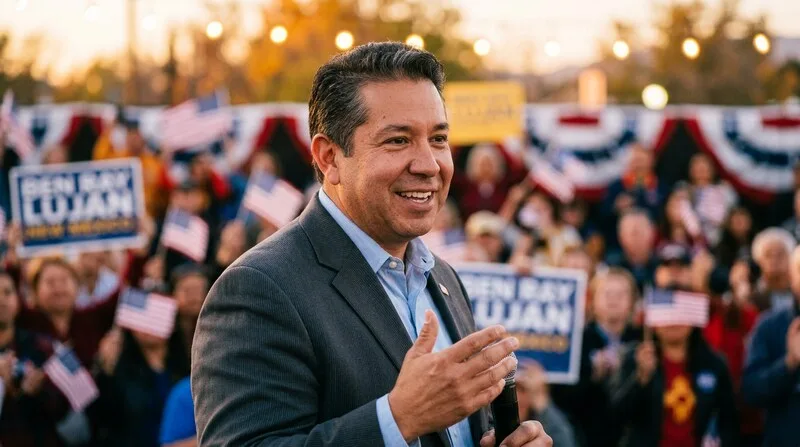
Biography & Career
Ben Ray Luján was born on September 7, 1972, in Nambé, New Mexico, into a family with deep roots in northern New Mexico’s Hispanic communities. His father, Ben Luján Sr., served as New Mexico House Speaker for many years, and the family’s political tradition shaped his upbringing and career path. He attended New Mexico Highlands University and later the University of New Mexico, focusing on business. He worked in state government, eventually serving as State Corporation Commission Chair before winning the NM-3 House seat in 2008.
NM-3 is one of the most geographically large congressional districts in the country, covering northern and western New Mexico including large Native American tribal nations, rural Hispanic communities, and mountainous terrain. Luján won re-election comfortably through six terms, developing a reputation as an effective constituent service member for a diverse and often underserved district. The Obama administration utilized his DCCC chairmanship as a strategic appointment, putting him in charge of House Democratic recruitment, candidate support, and campaign strategy from 2015 through the critical 2018 cycle.
His tenure as DCCC Chair from 2015 to 2019 is widely credited with producing the 2018 Democratic wave that gave the party its House majority. Under his leadership, the DCCC recruited strong candidates in suburban districts that had shifted toward Democrats during the Trump years, focused on healthcare as the defining issue, and built the financial infrastructure that supported competitive races. The resulting majority of 235 Democratic House seats was the largest in the party since 2010. He ran for the Senate in 2020 after Tom Udall retired, winning a competitive general election over Republican Mark Ronchetti by about 10 points, a tighter margin than some expected in a state Biden carried by 11.
His January 2022 stroke came at a moment when Democrats held the Senate by the slimmest possible margin — 50-50 with Vice President Harris casting tie-breaking votes. His hospitalization raised real concerns about the Democratic majority’s durability. His full recovery and return to service was greeted with relief across the Democratic caucus and provided one of the more dramatic personal narratives in recent Senate history.
Key Policy Positions
Healthcare Access
Luján has made healthcare access a signature Senate priority, particularly for rural New Mexico communities that are chronically underserved by the healthcare system. He has been a consistent defender of the Affordable Care Act, a supporter of expanded Medicaid, and an advocate for Community Health Centers that serve rural and tribal communities. His own health experience since his stroke has reinforced his personal commitment to healthcare advocacy, and he has spoken publicly about the importance of accessible care and the challenges facing patients navigating complex medical systems.
Rural Broadband & Tribes
New Mexico’s large tribal nations and rural communities have historically had among the worst broadband access in the country — a gap that Luján has worked to address through legislation and federal program advocacy. He has pushed for dedicated funding for tribal broadband infrastructure, rural broadband deployment programs, and digital equity measures that address the significant divide between urban and rural internet access. His NM-3 House district experience gave him direct understanding of how broadband absence limits economic opportunity, telehealth access, and educational equity in underserved communities.
Clean Energy & Climate
New Mexico has enormous renewable energy potential — its high desert geography offers world-class solar resources, and wind potential in the eastern plains rivals Texas. Luján has been a supporter of federal clean energy investment, renewable energy development on federal and tribal lands, and policies that could diversify New Mexico’s economy beyond its historical dependence on oil and gas revenues. The tension between fossil fuel industry employment (significant in southeastern New Mexico) and the clean energy transition represents a real political challenge he must navigate in a state where both constituencies matter to Democratic coalition maintenance. The 2026 political environment and whether Democrats can effectively make the economic case for clean energy will shape his re-election context.
2026 Re-Election Context
Luján faces re-election in 2026 in a New Mexico that Biden won by 11 points in 2020. The race is rated likely or safely Democratic by major forecasters, though his 2020 win was narrower than expected and New Mexico’s rural areas have continued trending Republican. His Republican opponent has not been determined, but the field of potential challengers includes Mark Ronchetti, who lost to him in 2020, and potentially Deb Haaland if she decides to run for governor rather than seek a return to Congress.
The national environment will matter significantly. The generic ballot showing Democrats with a substantial advantage in 2026 positioning is favorable for Luján, and the historical pattern of the party out of power gaining seats in midterms would help his party’s broader caucus while benefiting him personally. His profile as a stroke survivor who returned to work is a compelling constituent narrative, and his name recognition in New Mexico after more than a decade in the House and then the Senate is an advantage.
New Mexico’s demographics — approximately 47% Hispanic, 11% Native American, and a large federal government and military workforce — give Democrats structural advantages in a state where the politics of the economy, federal services, and representation matter deeply. Luján’s identity as a northern New Mexico Hispanic politician with deep family roots in the state gives him authentic connection to these communities. His Senate 2026 race will be one that national Democrats watch but expect to hold.