- Deb Haaland (D-NM) served as US Secretary of the Interior 2021–2025, the first Native American Cabinet secretary in US history, representing the Laguna Pueblo people as a 35th-generation member.
- As a progressive House member for NM-1 (Albuquerque) before the Cabinet, she co-sponsored the Green New Deal and served on the Natural Resources and Armed Services committees.
- Her landmark Interior achievement was the Federal Indian Boarding School Investigation — a 2022 report documenting 408 federally-funded schools, 53 burial sites, and generations of cultural trauma.
- After leaving the Cabinet, Haaland’s potential 2026 New Mexico governor candidacy is widely discussed as Governor Lujan Grisham reaches her term limit in a blue-leaning state with a large Native American population.
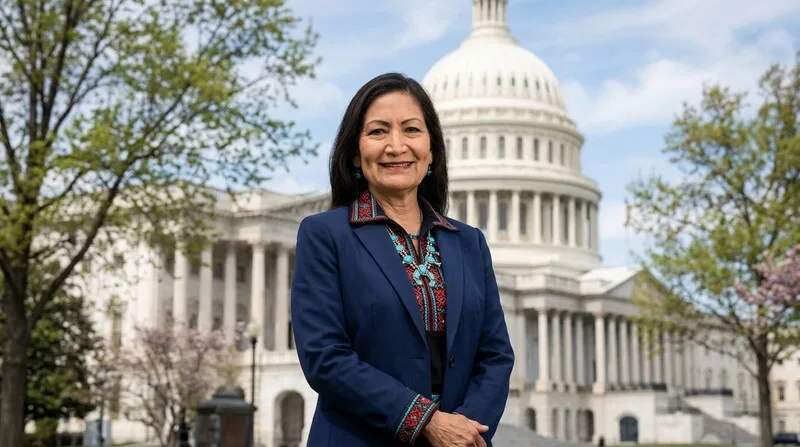
Biography & Congressional Career
Deb Haaland was born in 1960 at Winslow, Arizona, into a military family — her father was a Marine and her family moved frequently. As a member of the Laguna Pueblo people, a federally recognized tribe in central New Mexico, she represents 35 generations of continuous Indigenous presence in the Southwest. She attended the University of New Mexico, later earning her law degree from UNM School of Law in 2006 after navigating a difficult economic path that included raising her daughter as a single mother and working multiple jobs.
Haaland became politically active in New Mexico Democratic politics, eventually serving as the chair of the New Mexico Democratic Party from 2015 to 2017. In 2018, she ran for the House seat in NM-1, which covers Albuquerque and its suburbs. She won decisively in the Democratic-leaning district and was sworn in as one of the first two Native American women ever elected to Congress — alongside Sharice Davids of Kansas. She served on the House Natural Resources Committee and Armed Services Committee, developing a legislative focus on Indigenous rights, public lands, and clean energy.
As a House member, Haaland co-sponsored the Green New Deal resolution introduced by Alexandria Ocasio-Cortez and other progressive members. She built a reputation as a committed environmental and Indigenous rights advocate, focusing specifically on the intersection of federal land management and tribal sovereignty. When President-elect Biden named her as his choice for Interior Secretary, the historic significance was immediately apparent: the Interior Department oversees the Bureau of Indian Affairs, manages tribal trust lands, and administers programs affecting all 574 federally recognized tribes — making it uniquely consequential for Native communities. Her Democratic Party colleagues celebrated the nomination as a watershed moment for Indigenous representation in the federal government.
Interior Secretary: Key Achievements
Federal Indian Boarding School Report
Haaland’s most lasting Interior legacy is the Federal Indian Boarding School Initiative. The 2022 report documented the history of 408 federal boarding schools operating between 1819 and 1969 under the forced assimilation policy known as “kill the Indian, save the man.” The investigation identified over 53 burial sites at former school locations. Haaland — whose own grandparents were sent to boarding schools — conducted national listening sessions with survivors. The initiative reopened national debate about federal apologies, reparations, and the full historical record of US Indigenous policy.
National Monument Restorations
Shortly after taking office, Haaland moved to restore Bears Ears and Grand Staircase-Escalante National Monuments in Utah to their original boundaries, reversing major reductions the Trump administration had made in 2017. Bears Ears in particular had been designated by Obama following intensive advocacy by a coalition of five Native American tribes who regard the land as sacred. Restoring the monument was both a conservation victory and a significant symbolic action for tribal sovereignty over ancestral lands. The action was immediately challenged in court by Utah state officials and industry groups aligned with the prior administration.
Federal Land & Energy Policy
The Interior Department under Haaland moved to pause new oil and gas leasing on federal lands in 2021 as part of Biden’s broader climate policy agenda. The pause was contested in federal court and partly reversed by judicial orders, but reflected Haaland’s orientation toward conservation and clean energy transition on the approximately 30% of US land area that falls under federal management. She also advanced offshore wind leasing in the Atlantic and Gulf of Mexico as part of the administration’s push toward renewable energy development on federal lands and waters.
Career Timeline
| Year | Event | Significance |
|---|---|---|
| 1960 | Born in Winslow, Arizona | Member of Laguna Pueblo; raised in military family; 35th-generation New Mexican |
| 2006 | JD, University of New Mexico School of Law | Earned law degree as a single mother after difficult economic path |
| 2015–2017 | Chair, New Mexico Democratic Party | Built statewide political network in advance of congressional run |
| 2018 | Elected to House, NM-1 (Albuquerque) | One of first two Native American women elected to Congress; alongside Sharice Davids |
| 2019–2021 | House Natural Resources & Armed Services | Co-sponsored Green New Deal; focused on Indigenous rights and public lands |
| Mar 2021 | Confirmed 54th Secretary of the Interior | First Native American Cabinet member in US history; vote 51-40 |
| 2022 | Released Federal Indian Boarding School report | Documented 408 schools, 53+ burial sites; national reckoning with US Indigenous history |
| 2023 | Restored Bears Ears & Grand Staircase monuments | Reversed Trump-era reductions to Utah monument boundaries |
| 2025 | Left Interior as Biden term ended | Returned to New Mexico; 2026 governor race widely discussed |
Policy Positions
| Issue | Position | Key Action |
|---|---|---|
| Indigenous rights | Champion | Led federal Indian boarding school investigation; prioritized tribal consultation in land decisions |
| Public lands | Conservation-first | Restored monuments; paused federal oil/gas leasing; expanded offshore wind |
| Climate | Progressive | Used Interior to advance clean energy on federal lands; aligned with Biden climate agenda |
| Fossil fuels | Skeptical | Sought to reduce new drilling leases on federal lands; faced legal challenges and political pushback |
| Water rights | Tribal-focused | Prioritized tribal water rights in western drought negotiations under Colorado River Compact stress |
| Healthcare | Supportive | Backed ACA expansion as House member; focused on Indian Health Service underfunding as Interior priority |
Post-Cabinet Future: 2026 New Mexico Governor Race
After leaving the Interior Department in January 2025 when the Biden administration concluded, Haaland returned to New Mexico as a nationally prominent Democratic figure with a historic record. New Mexico Governor Michelle Lujan Grisham is term-limited, making 2026 an open governor’s race in a blue-leaning state. Haaland has been prominently mentioned as a potential candidate, and a gubernatorial run would carry obvious historic significance in a state where Native Americans constitute approximately 11% of the population — one of the highest proportions of any state.
New Mexico’s political landscape offers a relatively favorable environment for a Democratic gubernatorial candidate: the state has voted for the Democratic presidential nominee in every election since 2004, and Albuquerque and Santa Fe provide strong Democratic bases. However, rural New Mexico, including oil and gas producing Lea and Eddy counties in the southeast that have grown rapidly with the Permian Basin boom, has trended Republican, making a statewide race more competitive at the margins than registration numbers suggest.
Haaland’s Interior record on fossil fuel leasing could become a general election vulnerability in a state where oil and gas revenues fund a substantial portion of the state budget and directly impact economic conditions for many New Mexico families. But her personal story, historic significance, and strong Democratic base support make her a formidable potential candidate. Whether she ultimately enters the race will be one of the more closely watched decisions in Southwest Democratic politics ahead of the 2026 cycle.