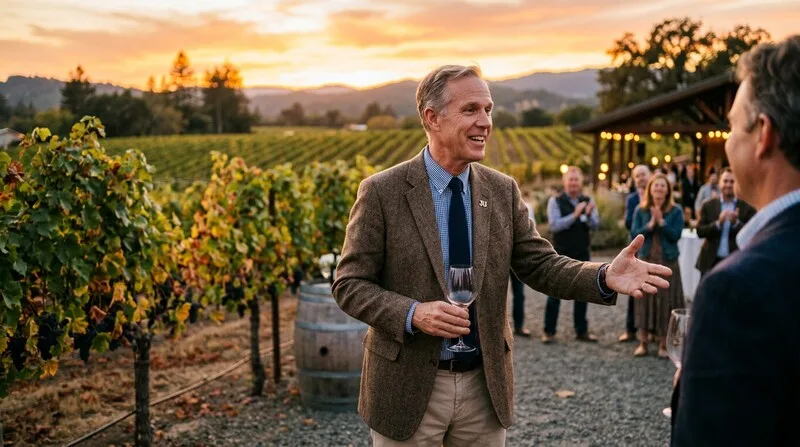
- Jared Huffman (D-CA) represents California's 2nd Congressional District, covering the Northern California coast from Marin County to the Oregon border — a D+20 safe Democratic seat he has held since 2013.
- He is the only openly nonreligious member of Congress — identifying as a "humanist" and co-founding the Congressional Humanist Caucus — a rare example of open non-theism in American political office.
- Huffman is a former water rights attorney and California Assemblyman whose deep expertise in water law shapes his environmental policy work, particularly on salmon habitat, dam removal, and drought management.
- He serves on the House Natural Resources Committee as ranking member, focusing on public lands, endangered species, clean water, and climate policy — issues central to his heavily forested, coastal district.

Biography
Jared Huffman grew up in California and earned his law degree from Boston College Law School. He worked as a staff attorney for the Natural Resources Defense Council, litigating environmental cases including water rights and fisheries law in California, before entering electoral politics. He served in the California State Assembly from 2006 to 2012, representing a Marin County-based district, and built a legislative record focused on water policy and environmental protection before running for Congress in 2012 when long-serving Democratic representative Lynn Woolsey retired.
Huffman won CA-2 easily in 2012 and has been re-elected every two years since without meaningful competition. The district’s D+20 Cook PVI reflects its character as one of California’s most reliably liberal constituencies — a combination of Humboldt County’s progressive academic and cannabis-industry communities, Mendocino County’s arts and wine country culture, and Marin County’s affluent liberal suburbs north of San Francisco.
In 2017, Huffman publicly identified as a non-theist — a humanist who does not hold religious beliefs — making him one of the very few members of Congress to openly hold a non-religious identity. He co-founded the Congressional Freethought Caucus in 2018 with Maryland Democrat Jamie Raskin. His Natural Resources Committee work on forests, fisheries, and public lands management reflects both his district’s economic character and his pre-congressional career as an environmental lawyer.
Key Policy Positions
Environment & Public Lands
Huffman’s legislative career has centered on environmental protection. His Natural Resources Committee work covers federal public lands management, forest policy, fisheries, ocean protection, and national parks — issues central to the North Coast’s economy and character. He has been a strong advocate for dam removal to restore salmon runs on California rivers, including the Klamath River project, one of the largest dam removal and river restoration efforts in American history. He opposes logging in old-growth forests and has pushed for stronger federal wildfire management policy.
Climate Policy
Huffman has been among the House’s most consistent voices for aggressive federal climate polling. He has supported carbon pricing, clean energy investment, and the climate provisions of the Inflation Reduction Act, and has pushed for even more ambitious federal targets. His district’s fishing industry is directly affected by ocean warming and acidification, giving him a constituent-level stake in climate outcomes beyond the abstract policy debate. He has been critical of fossil fuel subsidies and has supported rapid transition away from oil and gas dependency.
Secular Governance
Through the Congressional Freethought Caucus, Huffman has been a voice for church-state separation, science-based policymaking, and secular governance. He has been critical of religiously motivated legislation and has advocated for protecting the rights of non-religious Americans. His openness about his own non-theistic beliefs — unusual among elected officials — has made him a figurehead for secular humanist organizations and for Americans who feel unrepresented by a Congress in which religious profession is nearly universal among members.
The Klamath Dam Removal: Huffman’s Signature Achievement in Numbers
The removal of four hydroelectric dams on the Klamath River (2023–2024) was the largest dam removal and river restoration project in American history — a decades-long effort Huffman championed legislatively and helped fund through the IRA and federal appropriations.
| Dam | Built | Removed | Height | Significance |
|---|---|---|---|---|
| Copco No. 1 | 1918 | 2023 | 127 ft | Upstream anchor; blocked salmon migration for 105+ years |
| Copco No. 2 | 1925 | 2023 | 32 ft | Small diversion dam; removed first in sequence |
| J.C. Boyle | 1958 | 2024 | 50 ft | Oregon-side dam; most upstream, longest blocked reach |
| Iron Gate | 1964 | 2024 | 173 ft | Lowest dam; key to reopening 400+ miles of salmon habitat |
| Total Impact | — | 2023–24 | — | Largest US dam removal ever; ~800K cubic yards sediment released; Coho salmon returning |
North Coast Political Context
CA-2 is one of California’s most distinctive congressional districts geographically — it stretches for hundreds of miles along the Pacific Coast from the Oregon border to just north of San Francisco, encompassing rugged coastal communities, old-growth redwood forests, and the wine country of Mendocino County. The district’s economic mix of fishing, timber (much reduced from its historical levels), cannabis, wine, and tourism gives it a character quite different from California’s major urban districts.
More to Explore




Watch: Jared Huffman Torches GOP on Natural Resources Committee
External resources: Jared Huffman on Ballotpedia — Jared Huffman on Wikipedia