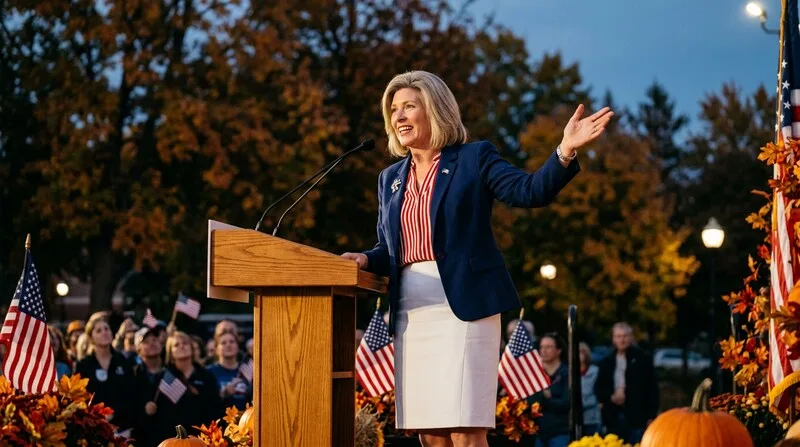
- Joni Ernst (R-IA) has served as Iowa’s senior US Senator since 2015, the first female combat veteran elected to the US Senate. She deployed to Kuwait during Operation Iraqi Freedom and retired from the Iowa Army National Guard as a Lieutenant Colonel.
- She serves on the Senate Armed Services Committee and Agriculture Committee — two assignments critical to Iowa’s priorities as both a farm state and a state with significant military population.
- Ernst has been a vocal DOGE champion, working alongside Elon Musk’s efficiency initiative and pushing for sweeping federal workforce reductions and spending cuts — a stance that plays well with Iowa Republicans.
- Her 2026 re-election race is rated Safe Republican, though Iowa has attracted some Democratic attention given national headwinds for the Republican Party. Iowa has shifted substantially right since the Obama era when it was a genuine swing state.
Biography & Military Career
Joni Ernst was born on July 1, 1970, in Red Oak, Iowa, and grew up on a farm in Montgomery County in southwest Iowa. She attended Iowa State University, earning a bachelor’s degree in public administration, and later earned a master’s degree in public administration from Columbus State University in Georgia. Her rural Iowa upbringing — she famously marketed herself as someone who “castrated hogs” on a family farm — became central to her political persona and advertising.
Ernst served in the Iowa Army National Guard for over two decades, deploying to Kuwait in 2003 during Operation Iraqi Freedom as a company commander. She rose to the rank of Lieutenant Colonel and eventually became one of the highest-ranking women in the Iowa National Guard before retiring. Her military service gives her standing on defense issues that is genuine rather than rhetorical, and she has been a consistent advocate for veterans’ benefits and military readiness throughout her Senate career.
She entered electoral politics at the county level, serving as Montgomery County Auditor before winning a state Senate seat in 2011. In 2014, she ran for the open US Senate seat being vacated by Democrat Tom Harkin, winning a tough Republican primary with strong support from grassroots conservatives and the then-emerging Tea Party network. Her general election campaign against Democrat Bruce Braley was competitive but she won by nearly 9 points in a favorable Republican wave year. She was re-elected in 2020 by a 6-point margin over Democrat Theresa Greenfield in a tougher environment — a race national Democrats heavily invested in but ultimately fell short in as Iowa continued its rightward shift.
In the Senate, Ernst secured assignments on the Armed Services and Agriculture committees that directly serve Iowa’s interests. She has been a consistent conservative vote on fiscal, social, and foreign policy issues while occasionally working across the aisle on veterans’ legislation and farm policy. Her relationship with Donald Trump evolved from skepticism in 2016 to strong support, and she was one of the more prominent Senate validators of his DOGE-driven spending cut agenda in 2025.
Key Policy Positions
Defense & Veterans
Ernst’s military background makes defense and veterans’ policy her most credible legislative territory. She has been a strong advocate for military readiness and modernization spending on the Armed Services Committee, and has pushed for reforms to the Department of Veterans Affairs to improve care and reduce bureaucratic backlog. Her co-sponsorship of the Veterans Choice Act and subsequent veterans’ healthcare reform efforts have been bipartisan accomplishments in an otherwise polarized legislative environment. She has also been attentive to military base interests in Iowa.
Agriculture & Rural Iowa
As a member of the Senate Agriculture Committee, Ernst has been central to farm bill negotiations that govern billions in crop subsidies, crop insurance, and rural development programs critical to Iowa’s corn, soybean, and hog farming economy. She has navigated tensions between the fiscal conservative wing of the Republican Party — which periodically targets agricultural subsidies — and Iowa farmers who depend on federal support. Her rural Iowa identity gives her standing with agricultural constituents that is more credible than many urban Republican colleagues.
DOGE & Federal Spending
Ernst emerged as one of the Senate’s most visible DOGE champions in 2025, working alongside the Trump administration’s efficiency agenda and publicly supporting mass federal workforce reductions. She has called for deep cuts across numerous federal departments and agencies, framing the effort in terms of eliminating waste and reducing the national debt. The economic implications of DOGE cuts — particularly for federal contractors and employees in Iowa — have drawn some constituent concern, but Ernst has maintained strong support within the Iowa Republican base for her fiscal posture.
Iowa Senate Election History
| Year | Ernst (R) | Democrat | Margin | Context |
|---|---|---|---|---|
| 2014 | 52.2% | Braley 43.7% | R+8.5 | Republican wave year; open seat; Braley damaged by farm comments gaffe |
| 2020 | 51.8% | Greenfield 45.2% | R+6.6 | Heavily contested; Biden won White House but Iowa continued rightward shift |
| 2026 | Favored (expected) | TBD | Safe R | Iowa now R+13 at presidential level; Democrats targeting but field unclear |
2026 Re-Election Context
Joni Ernst faces re-election to the Senate in 2026. Iowa has shifted dramatically rightward since the Obama era when it was a genuine swing state — Obama carried Iowa twice, but Trump won it by 8 points in 2016, 8 in 2020, and 13 in 2024. At the presidential level, Iowa is no longer competitive, and Ernst’s re-election odds are strong. The race is rated Safe Republican by major forecasters.
However, the generic ballot showing a significant Democratic advantage nationally in early 2026 polling, combined with what forecasters describe as a historically unfavorable environment for the party holding the White House in midterm elections, means Democrats have at least theoretical interest in the Iowa race. Whether a credible challenger emerges from the Democratic field — and whether national Democratic organizations invest in Iowa — will determine how competitive the race ultimately becomes.
Ernst’s approval ratings in Iowa have tracked below 50% in some surveys, which is a mild vulnerability in an otherwise firm Republican state. Her DOGE support and the potential impact of federal spending cuts on Iowa farmers and federal workers could generate negative attention. But she enters the cycle with strong name recognition, a significant fundraising advantage, and the structural benefit of running in one of the most Republican-trending large Midwestern states. The House 2026 races in Iowa’s competitive congressional districts will provide useful temperature readings for the broader state environment.