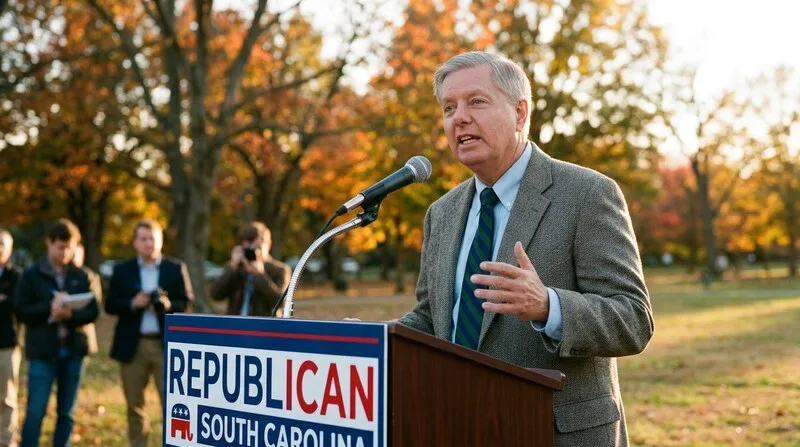
- Lindsey Graham (R-SC) has served as South Carolina’s senior senator since 2003, serving on the Senate Judiciary and Armed Services Committees for his entire career, making him one of the most experienced voices on both judicial nominations and national security.
- His career is defined by a dramatic political evolution: from a bipartisan McCain ally who worked with Democrats on immigration reform and campaign finance to one of Donald Trump’s most vocal Senate defenders after initially opposing Trump’s 2016 candidacy.
- As a foreign policy hawk, Graham has consistently supported strong US military presence, NATO commitments, Ukraine aid, and confrontational postures toward China and Russia — occasionally putting him in tension with the more isolationist wing of the Trump coalition.
- Graham was re-elected in 2020 and next faces voters in 2026 in a Safe Republican South Carolina where Trump won by 11 points. His re-election is expected to be straightforward absent a primary challenge from his right.
Biography & Career Evolution
Lindsey Graham was born on July 9, 1955, in Central, South Carolina, into a family that ran a pool hall and restaurant. He attended the University of South Carolina and the University of South Carolina School of Law, then joined the Air Force where he served as a Judge Advocate General (JAG) officer, an experience that would define his legal perspective and Senate committee work. He rose to the rank of Colonel in the Air Force Reserve, serving part-time while pursuing his political career.
Graham was elected to the House of Representatives from South Carolina in 1994 as part of the Gingrich Revolution that gave Republicans their first House majority in 40 years. He served four House terms and was one of the House managers in the Clinton impeachment trial in 1998 — an experience that informed his perspective on later impeachment proceedings he would participate in from the Senate side. He was elected to the Senate in 2002, succeeding the retiring Strom Thurmond.
In his early Senate career, Graham was closely associated with his mentor and friend, Senator John McCain of Arizona. Together, they were part of the “Gang of 14” that negotiated a compromise on judicial filibusters in 2005, and co-sponsored comprehensive immigration reform bills that drew intense criticism from the conservative base. Graham’s willingness to work across the aisle on immigration, climate change (with Democrat John Kerry), and campaign finance reform (the McCain-Feingold Act) made him a target of Tea Party primary challenges and earned him the “RINO” label from some conservative critics.
His relationship with Donald Trump evolved dramatically. Graham was one of Trump’s harshest critics during the 2016 Republican primary, calling him “unfit” for the presidency. But after McCain’s death in 2018, Graham became one of Trump’s most visible and vocal Senate allies, defending Trump through both impeachment trials and becoming a regular presence at Mar-a-Lago. His transformation is frequently cited as a case study in the Republican Party’s realignment around Trump.
Key Policy Positions
Foreign Policy & Defense
Graham is one of the Senate’s most consistent foreign policy hawks. He supported US military action in Iraq and Afghanistan, has been a consistent advocate for strong US presence in the Middle East, and has pushed for robust responses to Russian and Chinese aggression. He supported Ukraine aid packages even as some Republican colleagues opposed them, and has been a strong defender of the NATO alliance. His foreign policy views place him in the hawkish tradition of the late John McCain, and he has been willing to push back on Trump administration positions he views as too accommodating toward adversaries.
Judiciary & Courts
As a former JAG officer and longtime Judiciary Committee member who served as both chair and ranking member, Graham has been central to every major judicial confirmation battle of the past two decades. He played key roles in the Kavanaugh and Barrett Supreme Court confirmation hearings, delivering memorable floor speeches that became viral moments. He has generally supported conservative judicial nominees and opposed Democratic nominees, though he joined bipartisan efforts to confirm some district court judges to reduce backlogs. His legal background gives him command of constitutional law discussions most senators cannot match.
Immigration & Border
Graham’s immigration record is complex. He co-authored multiple comprehensive immigration reform bills with Democratic colleagues in the 2000s and 2010s that would have paired enforcement with a path to legal status for undocumented immigrants — positions that drew Tea Party fire. More recently, he was involved in the 2024 bipartisan border security bill negotiations before Trump urged its defeat. His border posture has generally shifted toward enforcement-first while retaining his interest in comprehensive reform that addresses all aspects of the immigration system.
Senate Election History
| Year | Graham (R) | Democrat | Margin | Context |
|---|---|---|---|---|
| 2002 | 54.3% | Sanders 44.0% | R+10.3 | Open seat; succeeded Strom Thurmond; national Republican wave |
| 2008 | 57.5% | Conley 39.5% | R+18.0 | Held comfortably despite Obama wave; SC firmly Republican |
| 2014 | 55.3% | Hutto 40.7% | R+14.6 | Survived Tea Party primary; won general easily in Republican wave |
| 2020 | 54.4% | Harrison 44.2% | R+10.2 | Heavily contested; Democrat Jaime Harrison raised record funds but fell 10 points short |
| 2026 | Favored | TBD | Safe R | SC Trump+11; next race; expected comfortable win |