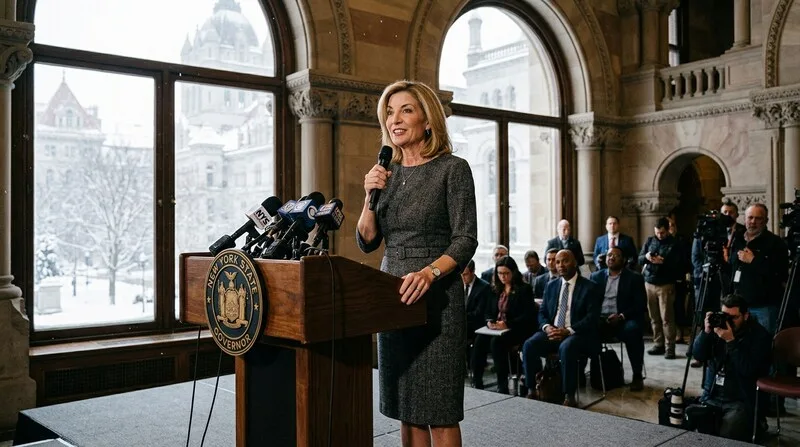
- Kathy Hochul (D-NY) won election as New York governor in 2022 by 5.7 points over Republican Lee Zeldin — a narrower-than-expected margin in one of the most Democratic states that reflected New York's crime and public safety concerns.
- She became governor in August 2021 when Andrew Cuomo resigned amid sexual harassment allegations — the first woman to serve as New York governor — before winning her own full term in 2022.
- New York is D+25 — one of the most reliably Democratic states, but Hochul's 5.7-point win was much closer than typical statewide Democratic margins, driven by strong Republican performance in New York City's outer boroughs and suburbs.
- Hochul has focused on housing production and public safety — signing major housing legislation to increase supply in a state with a severe affordability crisis, while also defending her record on subway safety after high-profile violent incidents on the MTA.

Biography
Kathleen Courtney Hochul was born on August 27, 1958, in Buffalo, New York, and grew up in the Buffalo area — a working-class background in western New York that she frequently references as central to her political identity. She attended Syracuse University and the Catholic University of America Columbus School of Law, earning her law degree in 1983. She worked as an attorney and in congressional staff roles before entering electoral politics.
Hochul served on the Hamburg, New York Town Board and as Erie County Clerk before winning a competitive special election for New York's 26th Congressional District in May 2011. The district — a Republican-leaning Buffalo-area seat — had been held by Republican Chris Lee, who resigned after a personal scandal. Hochul won the special election in a nationally watched upset, benefiting partly from a third-party candidate who split the Republican vote. She lost her bid for a full term in 2012 when the district was redrawn and became more Republican.
After her congressional defeat, Hochul returned to state-level politics. She ran for lieutenant governor in 2014 on the ticket with Governor Andrew Cuomo, and was re-elected alongside Cuomo in 2018. Her eight years as lieutenant governor were relatively low-profile — she focused on agriculture, small business, and upstate economic development while Cuomo dominated New York's political oxygen.
Everything changed in August 2021, when Andrew Cuomo resigned as governor amid a sexual harassment investigation conducted by the state attorney general. Hochul was sworn in as New York's first female governor on August 24, 2021. She moved quickly to establish her own governing identity, distinct from the often abrasive and autocratic style of her predecessor, appointing diverse cabinet members and working to restore confidence in Albany after years of Cuomo-era dysfunction.
The 2022 election proved far more difficult than expected. Hochul won the Democratic primary against strong challengers including New York City Public Advocate Jumaane Williams and former governor Cuomo lieutenant Tom Suozzi. She then faced Republican Lee Zeldin in the general election. Despite New York's massive Democratic registration advantage, Zeldin's focus on crime and cost of living resonated with suburban and outer-borough voters. Hochul won by only 5.5 points — the closest New York gubernatorial race in decades — as Zeldin's strong turnout helped flip four New York congressional seats to Republicans, contributing to the party's narrow House majority.
Her full term has been defined by attempts to address housing costs, improve the troubled MTA transit system, manage the influx of migrants to New York City, and navigate tensions with progressive Democrats in the legislature and moderate Democratic voters who remain concerned about crime and costs. Her decision in June 2024 to indefinitely pause New York City's congestion pricing program — which would have charged drivers entering lower Manhattan — was one of the most controversial decisions of her governorship, drawing sharp criticism from transit advocates and environmental groups who had spent years securing its passage.
Key Policy Positions
Housing & Cost of Living
Hochul has pushed for major housing production increases in New York, one of the most expensive housing markets in the country. She proposed ambitious new housing construction targets and has worked to streamline permitting and incentivize development. Her housing proposals have faced resistance from suburban communities opposed to denser development, and full implementation has been incremental.
Public Safety & Criminal Justice
After the 2022 near-loss driven partly by crime concerns, Hochul has positioned herself as a moderate on public safety issues. She has supported reforms to New York's bail laws — which became a major Republican attack line — and has emphasized law enforcement funding alongside criminal justice reform. Her positioning is deliberately centrist, seeking to hold both suburban voters worried about crime and the progressive base.
Economic Development
Hochul has pursued an aggressive economic development agenda, including securing major semiconductor investment (the CHIPS Act-linked Micron facility in Syracuse), expanding the film tax credit, and promoting New York as a financial and tech hub. She is pro-business by the standards of Democratic governors, prioritizing job creation and investment as central to her political brand.
2026 Outlook
Hochul faces re-election in 2026, and the political environment is significantly more challenging than a typical New York Democratic incumbent would expect. Her approval rating sits around 44% — below the comfort zone for incumbents, reflecting dissatisfaction from both the left (over the congestion pricing pause, perceived closeness to real estate interests, and moderate stances on criminal justice) and from voters in the center who remain unconvinced she has managed the state's cost of living and transit problems effectively.
Lee Zeldin — the Republican who nearly defeated her in 2022 — has emerged as a potential rematch opponent. Zeldin's high-profile role in the Trump administration as EPA Administrator has given him continued national visibility and a platform that could translate back into New York statewide politics if he returns. A Hochul-Zeldin rematch in 2026 would be one of the most watched gubernatorial races in the country, with significant implications for New York's congressional delegation and national Democratic morale.
Democratic primary challenges are also possible. Hochul has drawn criticism from progressive Democrats who view her as insufficiently aligned with the party's activist base. Tom Suozzi and other figures have been mentioned as potential primary challengers. A contested Democratic primary would further complicate her path to re-election in what would already be a competitive general election environment.
Hochul's political fate is closely tied to conditions in New York City — crime perceptions, subway safety, cost of living, and migration management. If those conditions improve substantially by 2026, her path to re-election is manageable. If they do not, she faces a genuine risk of becoming only the second sitting New York governor to lose re-election in the modern era.
Electoral History
Frequently Asked Questions
Who is Kathy Hochul?
Kathy Hochul is the Democratic Governor of New York and the state's first female governor, assuming office in August 2021 when Andrew Cuomo resigned amid a sexual harassment investigation. She won a full term in 2022 by approximately 5.5 points — a margin that surprised Democrats given New York's political lean. She is up for re-election in 2026 with an approval rating around 44%.
What happened with New York's congestion pricing under Hochul?
In June 2024, Hochul announced an indefinite pause on New York City's congestion pricing program, which would have charged drivers entering lower Manhattan and used the revenue to fund MTA transit improvements. The decision was widely condemned by transit advocates, environmental groups, and many Democrats who had spent years securing the program's passage. Hochul cited economic concerns. The pause was legally challenged and became a major point of criticism from her left.
Could Lee Zeldin defeat Hochul in 2026?
A Hochul-Zeldin rematch in 2026 is possible if Zeldin returns to New York politics after his tenure as EPA Administrator in the Trump administration. Given his 2022 near-miss — when he came within 5.5 points of defeating Hochul in a Democratic state — and Hochul's below-50% approval ratings, a 2026 rematch would be genuinely competitive. It would depend heavily on the national political environment, conditions in New York City, and whether Hochul faces a significant Democratic primary challenge first.