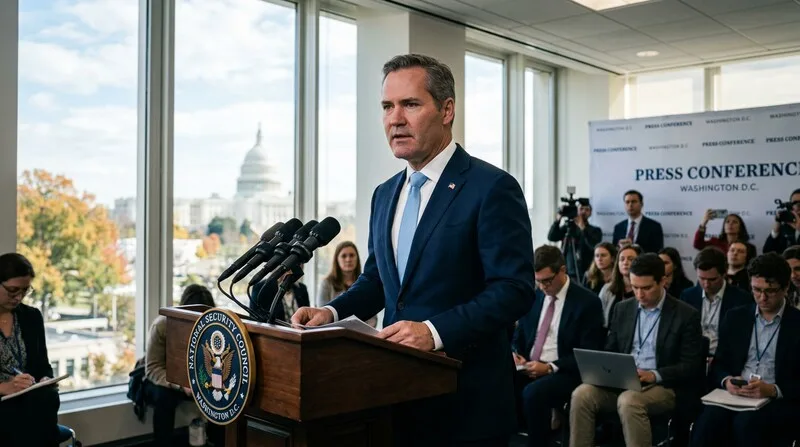
- Mike Waltz (R-FL) served as Donald Trump’s National Security Advisor from January to May 2025, one of the most senior foreign policy positions in the US government, before departing following a controversy over a Signal group chat.
- He is a retired Army colonel and Special Forces Green Beret who completed multiple combat deployments in Afghanistan and Africa — one of the most decorated members of Congress in recent years before joining the executive branch.
- As a Florida congressman from 2019 to 2025, Waltz was a leading China hawk and defense policy voice, serving on the House Armed Services and Foreign Affairs committees and consistently pushing for harder US postures toward Beijing.
- Following his departure from the NSA, Trump nominated Waltz as US Ambassador to the United Nations, a significant diplomatic post where his national security background and hawkish views would shape US representation at the global body.
Biography & Military Career
Michael Waltz was born on January 31, 1974, in Boiling Springs, South Carolina. He attended the Virginia Military Institute, earning a degree in international studies, and then commissioned into the US Army as an officer. He joined Special Forces — the elite Army Green Berets — and spent the bulk of his military career as a Special Forces officer conducting counterterrorism and unconventional warfare operations.
Waltz deployed to Afghanistan multiple times after the September 11 attacks, leading missions in some of the most dangerous areas of the country. His combat service earned him multiple military decorations including the Bronze Star with Valor. He also served in other roles supporting African counterterrorism operations and as a Pentagon policy official in the Bush administration. By the time he retired from the Army Reserve as a colonel, he had one of the most extensive combat records of any member of Congress in recent history.
After leaving active military service, Waltz founded a defense consulting firm and wrote two books on leadership and counterterrorism. He ran for Florida’s 6th congressional district in 2018, winning a competitive race in a district covering the Jacksonville area suburbs and coastal communities. He won re-election in 2020 and 2022 by comfortable margins as the district became safer for Republicans, serving on the House Armed Services and Foreign Affairs committees where his operational military expertise gave him standing that most members cannot match.
His congressional profile centered on China policy, defense readiness, and confronting what he argued were strategic threats to American power. He was a consistent voice warning about Chinese military buildup, cyber threats, technology theft, and influence operations in the United States — becoming one of the most prominent congressional China hawks at a time when this was an increasingly bipartisan concern. When Trump won the 2024 election, he named Waltz as National Security Advisor, bypassing the Senate confirmation process that cabinet positions require. The Trump administration’s first term NSA had been a tumultuous position, and Waltz’s military background was seen as bringing discipline and expertise to the role.
Key Policy Positions
China Policy
Waltz is one of the most prominent voices in American politics arguing for a hard competitive posture toward China. His congressional work focused on countering Chinese military modernization, restricting Chinese investment in sensitive US industries and farmland, confronting Chinese technology theft and intellectual property violations, and building deterrence against a potential military move on Taiwan. His view — informed by his intelligence and military background — is that the US is in a strategic competition with China that requires whole-of-government responses rather than just diplomatic engagement. As NSA and potentially as UN Ambassador, his China hawkishness shapes US policy formulation.
Defense & Military Readiness
From his decades of military service, Waltz has consistently argued that US military readiness — including sufficient defense spending, modern equipment, force structure, and the all-volunteer force recruitment and retention pipeline — is critically important for deterrence. He has been critical of what he views as politicization of the military through diversity and equity initiatives, arguing these distract from the core mission. He has also been a strong advocate for Special Operations Forces capabilities and the irregular warfare tools that were central to his own service.
Signal Controversy & NSA Departure
In March 2025, Waltz inadvertently added journalist Jeffrey Goldberg of The Atlantic to a Signal group messaging thread in which senior Trump national security officials — including Vice President Vance, Secretary of State Rubio, and Defense Secretary Hegseth — were discussing classified military strike plans against Houthi positions in Yemen. Goldberg subsequently published the contents of the conversation, creating a major national security controversy about classified information handling. Waltz left the NSA position in May 2025, and Trump announced he would nominate him as UN Ambassador, a move widely interpreted as a soft landing that removed him from the domestic political spotlight while utilizing his foreign policy credentials.