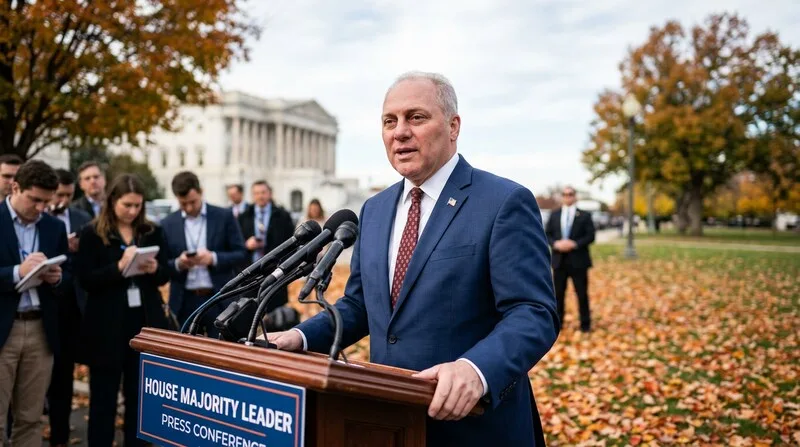
- Steve Scalise (R-LA) is the House Majority Leader, the second-ranking position in the House Republican leadership. He has held multiple leadership posts in the Republican caucus over 16+ years in Congress.
- In June 2017, Scalise was shot during a congressional baseball practice by a gunman targeting Republican legislators. The nearly fatal attack required extensive surgery and rehabilitation, and his recovery and return to Congress became a notable story of political resilience.
- As an Energy and Commerce Committee member, Scalise has been a leading advocate for domestic energy production, pipeline infrastructure, and opposition to carbon taxes — priorities central to Louisiana’s oil and gas economy.
- Scalise represents Louisiana’s 1st district (New Orleans suburbs), a Safe Republican seat where he wins re-election by wide margins. His political future may include a Louisiana Senate run when an opportunity arises.
Biography & Career
Steve Scalise was born on October 6, 1965, in Jefferson Parish, Louisiana, just outside New Orleans. He attended Louisiana State University, earning a degree in computer science, and began his career in information technology before entering Louisiana state politics in the early 1990s. He served in the Louisiana House of Representatives from 1996 to 2007 and in the Louisiana Senate briefly before winning the US House seat for Louisiana’s 1st Congressional District in a 2008 special election following Bobby Jindal’s election as governor.
LA-1 covers Jefferson Parish and surrounding suburban New Orleans areas — a district that has been reliably Republican for decades and that gave Scalise a safe platform from which to build his House career. He advanced quickly through Republican leadership, serving as Chairman of the Republican Study Committee, then NRCC Chair, then Majority Whip, and ultimately rising to Majority Leader under Speaker Mike Johnson. His ascent through leadership ranks marked him as one of the most influential House Republicans of his generation.
The defining personal crisis of his political career came on June 14, 2017, when a gunman opened fire on Republican members of Congress during a morning baseball practice at a park in Alexandria, Virginia. Scalise was shot in the hip, suffered severe internal injuries, and was taken to MedStar Washington Hospital Center in critical condition. He required multiple surgeries and spent months in rehabilitation. His recovery was long and difficult, and he returned to Congress in September 2017 to a standing ovation. The attack and his recovery shaped his public profile significantly, and he has spoken publicly about the experience’s impact on his perspective on service and resilience.
As House Majority Leader, Scalise is central to managing the Republican caucus’s legislative agenda, coordinating with Speaker Mike Johnson on scheduling, vote counting, and member relations. Louisiana’s oil and gas sector gives him a constituent-driven rationale for his energy policy positions, and his membership on Energy and Commerce has made him one of the most influential Republicans on those issues. The 2026 House elections and the question of whether Republicans maintain their majority will significantly shape Scalise’s political trajectory.
Key Policy Positions
Energy & Oil Production
Scalise’s signature issue is domestic energy production, reflecting Louisiana’s dominant oil and gas economy. He has been a consistent advocate for offshore drilling leases in the Gulf of Mexico (critical to Louisiana), pipeline infrastructure approval, LNG export terminals, and opposition to carbon taxes or cap-and-trade schemes that would raise energy costs. He views energy independence as a national security issue and has pushed back against Biden administration restrictions on federal energy leasing that he argued harmed Louisiana workers and the broader economy.
Tax & Fiscal Policy
As a senior House Republican, Scalise was deeply involved in the 2017 Tax Cuts and Jobs Act and has been a consistent advocate for extending the individual and business tax cuts that were set to expire. He has pushed for spending reductions to accompany any tax cut extensions and has been an active participant in budget negotiations that determine discretionary spending levels. His position as Majority Leader gives him direct influence over which fiscal legislation comes to the floor and what amendments are permitted, making him central to the House’s role in the appropriations process.
Immigration & Border
Scalise has been a consistent advocate for enforcement-first immigration policy, supporting the border wall, increased CBP funding, and strict enforcement of existing immigration law. He backed the Trump administration’s immigration orders in both terms and has been critical of Biden administration border policies. As a senior Louisiana politician, he has particular concern about visa overstays and immigration enforcement in Gulf Coast industries including fishing, agriculture, and construction that employ significant immigrant workforces.
Louisiana Political Context
Louisiana is one of the most reliably Republican states in the South at the federal level, with Trump winning it by large margins in both 2020 and 2024. The state’s political culture is shaped by its unique history — a French and Spanish colonial heritage that produced a distinct Catholic culture, a history of racial politics that has evolved significantly over the past half century, and an economy heavily dependent on oil and gas, petrochemical refining, and port commerce.
LA-1 specifically covers Jefferson Parish and the suburban New Orleans communities that have been the core of Louisiana’s Republican strength. The district is one of the safest Republican seats in the country, and Scalise wins re-election routinely without significant opposition. His political trajectory — whether he continues as Majority Leader, challenges for the Speakership, or eventually seeks a Louisiana Senate seat — depends heavily on how the 2026 midterms affect the Republican majority and his standing within it.
The broader Republican majority is currently thin, and the generic ballot showing Democrats with a significant advantage in early 2026 polling creates real uncertainty about whether Republicans will maintain their majority. As Majority Leader, Scalise’s power is directly tied to that majority. A Democratic House majority in 2027 would move him to Minority Leader and significantly reduce his legislative influence.