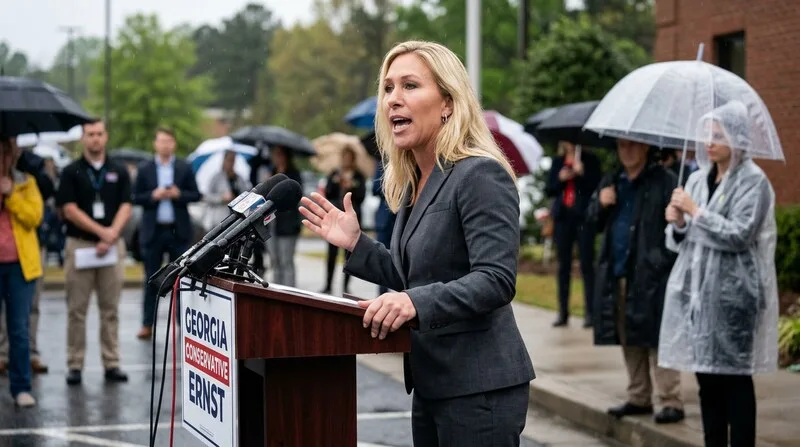
- Marjorie Taylor Greene (R-GA) represents Georgia’s 14th Congressional District, a Safe R+25 district in northwest Georgia she has held since 2021 with no serious electoral opposition.
- One of the most prominent MAGA-aligned House members, known for filing articles of impeachment against President Biden, Speaker McCarthy, and others during her tenure.
- Greene was stripped of all committee assignments in February 2021 by a bipartisan House vote over documented conspiracy theory endorsements, but regained them under Speaker McCarthy in 2023.
- She announced a 2026 Georgia Governor bid — a statewide race in a genuine swing state where Biden won in 2020, requiring appeal well beyond her northwest Georgia MAGA base.

Biography & Rise to Congress
Marjorie Taylor Greene was born on May 27, 1974, in Milledgeville, Georgia. She attended the University of Georgia, earning a business degree, and went to work in her family’s construction company Taylor Commercial, eventually becoming a co-owner and managing its day-to-day operations. The business background gave her a concrete perspective on taxes, regulation, and government contracting that became central to her political messaging.
Greene became politically engaged through the Tea Party movement during the Obama years and radicalized further during the Trump era, building a national social media following through provocative content including QAnon promotion, school shooting conspiracy theories, and fringe claims about Democratic leaders. When the GA-14 Republican congressman announced his retirement in 2020, Greene launched a primary campaign that successfully converted her online following into political power in northwest Georgia.
She won the August 2020 Republican primary decisively. Her Democratic opponent subsequently withdrew before November, and she was elected to Congress without a contested general election — effectively winning the seat in the primary alone. She arrived in Washington in January 2021 as one of the most controversial freshmen members in modern congressional history. Her relationship with Donald Trump has been the defining feature of her career, and she was one of his most visible defenders through his second impeachment trial, the January 6 House Select Committee investigation, and his 2024 presidential campaign.
As a member of the House Oversight Committee after Republicans took the majority in 2022, Greene pursued investigations into the Biden administration and became a top-tier small-dollar fundraiser whose donor base extends far beyond her Georgia district. Her 2024 motion to vacate Speaker Mike Johnson failed with only 11 votes, a marked contrast to the leverage the House Freedom Caucus had wielded in the thin-majority 118th Congress when McCarthy was removed. With her gubernatorial bid launched, her House career winds down in the 119th Congress.
Key Policy Positions
Ukraine & Foreign Policy
Greene has been among the most vocal opponents of US aid to Ukraine since Russia’s 2022 invasion, voting against every major aid package and arguing the US should not fund foreign wars while domestic needs go unmet. Her position aligns with roughly 30-35% of Americans who polls show are skeptical of Ukraine assistance — a number that tracks with the broader shift in Republican base opinion that mirrors Trump’s own posture on the conflict. She has been a consistent voice for a negotiated settlement on terms favorable to Russian positions.
Border & Immigration
On immigration, Greene advocates for the most restrictive enforcement posture available: mass deportations of undocumented immigrants, ending birthright citizenship, completing the southern border wall, and eliminating asylum pathways she characterizes as magnets for illegal entry. She supported Biden impeachment articles partly on grounds that his administration failed to enforce immigration law. Her immigration positions energize the MAGA base but tend to be broadly unpopular with general election voters in competitive Georgia suburban counties like Cobb and Gwinnett.
Federal Spending & DOGE
Greene consistently advocates dramatic federal spending reductions and government downsizing. She supported DOGE’s mass federal workforce reductions and has called for cuts across numerous agencies. Her willingness to vote against continuing resolutions and debt ceiling increases places her in the maximalist wing of House fiscal conservatives. While popular in deep-red GA-14, this posture will require careful calibration in a statewide Georgia race where suburban Atlanta voters are more focused on economic stability and federal services like Medicare and Social Security.
Career Timeline
| Year | Event | Context |
|---|---|---|
| 2020 | Elected to Congress, GA-14 | Won deep-red NW Georgia primary; ran unopposed in general after D candidate withdrew |
| Feb 2021 | Stripped of all committee assignments | House voted 230-199 (11 Rs + Dems) over QAnon posts, school shooting conspiracy claims, violent rhetoric |
| 2021 | Filed Biden impeachment articles on Day 1 | Filed repeatedly throughout his term; none advanced in Democrat-controlled House |
| 2022 | Re-elected with 66.6% | Regained committee assignments under new GOP majority; placed on House Oversight Committee |
| 2023 | Supported McCarthy removal, backed Johnson | Backed Gaetz-led motion to vacate McCarthy; McCarthy removed; then backed Mike Johnson as Speaker |
| 2024 | Motion to Vacate against Johnson failed | Only 11 votes for MtV against Johnson; marked decline of her leverage in larger Republican majority |
| 2025–2026 | Running for Georgia Governor | Will not seek 4th House term; statewide race in genuine swing state; Republican primary field forming |
The 2026 Georgia Governor Race: The Statewide Challenge
Greene’s decision to run for Georgia Governor in 2026 rather than seek a fourth House term is the most ambitious electoral step of her career. Georgia is a genuine swing state at the statewide level — Biden won it by 11,779 votes in 2020, Warnock defeated Walker in the 2022 Senate race, and Ossoff holds a Senate seat won in the January 2021 runoffs. A statewide Republican candidate in Georgia must appeal significantly beyond the MAGA base to win the general election, particularly in the Atlanta metropolitan suburbs that have trended Democratic with college-educated suburban voters in recent cycles.
The Republican primary presents its own challenges. Incumbent Governor Brian Kemp is term-limited after 2026, meaning the seat is open, but Kemp’s political allies and the Georgia Republican establishment are not aligned with Greene. Kemp famously refused to overturn the 2020 election results despite direct pressure from Trump, putting him in fundamental tension with Greene’s orbit. Georgia Secretary of State Brad Raffensperger, another 2020 election certifier in Trump’s crosshairs, has political allies who could complicate her primary path. The broader 2026 Senate races across swing states will provide useful context for whether the MAGA brand performs well in competitive general elections.
Greene enters the race with national name recognition, an enormous small-dollar fundraising base, and strong Trump endorsement potential. But Georgia’s statewide electorate — including the critical Cobb, Gwinnett, Cherokee, and Forsyth county suburban precincts that have swung presidential elections — represents a fundamentally different challenge from GA-14’s deep-red rural northwest. Her ability to expand her coalition beyond the MAGA base will determine whether she becomes Georgia’s next governor or another example of a candidate who dominated House politics but could not win statewide.