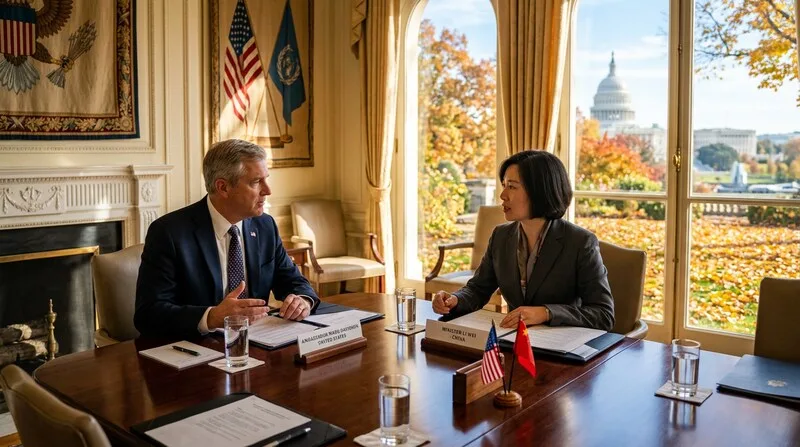
- 82% of Americans hold unfavorable views of China in 2026 — up from 47% in 2017, a dramatic and consistent shift driven by COVID origins, trade tensions, TikTok, Taiwan, and Xinjiang.
- China hawkishness is one of the few remaining areas of genuine bipartisan convergence: 87% of Republicans and 78% of Democrats share negative views, a smaller partisan gap than on any domestic issue.
- 52% support military defense of Taiwan if China invades — but that drops to 35–40% when respondents are told about potential U.S. casualties and economic disruption, revealing shallow commitment beneath strong rhetoric.
- U.S. tariffs on Chinese imports reached 145% as of April 2026 — the highest since the Smoot-Hawley era, making the trade war an unprecedented economic experiment with uncertain consumer price consequences.
The Partisan Hawkishness: Where Both Sides Agree
China policy polling is one of the few remaining areas of genuine bipartisan convergence in Washington. The convergence is not ideological harmony — Republicans frame China as a civilizational rival and communist threat, while Democrats emphasize human rights, labor standards, and multilateral coalition-building — but both coalitions support a confrontational posture. This bipartisan hawkishness has been building since roughly 2017 and accelerated through COVID-19, the TikTok debate, and escalating Taiwan tensions.
The gap between parties on China views is now smaller than the gap between generations. Younger Americans across party lines express somewhat less hawkish views than older cohorts, particularly on military intervention scenarios, though even younger Americans hold predominantly unfavorable views of the Chinese government.
| Issue | Republicans | Democrats | Overall |
|---|---|---|---|
| Unfavorable view of China | 87% | 78% | 82% |
| Support tariffs on Chinese goods | 72% | 54% | 63% |
| China is top economic threat | 71% | 56% | 63% |
| Defend Taiwan militarily | 55% | 49% | 52% |
| Ban TikTok on national security | 65% | 48% | 56% |
| Support semiconductor export controls | 74% | 68% | 71% |

Trade War vs. Decoupling: Two Schools of Thought
The Trade War Camp
Tariffs as leverage to force Beijing to the negotiating table. Goal: better trade terms, IP protection, market access. Associated with Trump administration strategy. Risk: retaliatory tariffs raise U.S. consumer prices without structural change.
The Decoupling Camp
Structural separation of supply chains in critical sectors: semiconductors, pharmaceuticals, rare earths, EVs. Goal: strategic autonomy regardless of bilateral trade volumes. Bipartisan support in Congress. Risk: significant short-term economic costs and allied friction.
The De-risking Camp
European framing adopted by some Democrats: reduce critical dependencies without full decoupling. Maintain commercial ties in non-strategic sectors. Invest domestically via CHIPS Act, IRA. Multilateral coordination through G7 and Quad. Most economically moderate approach.
Related Analysis
Trump Foreign Policy Approval
41% overall approval on foreign policy — breakdown by issue.
US-Russia Relations 2026
Post-Ukraine deal polling, NATO commitment, public opinion shifts.
US-Canada Trade War Polling
Tariffs, 51st state remarks, and surging Canadian anti-U.S. sentiment.