Biography
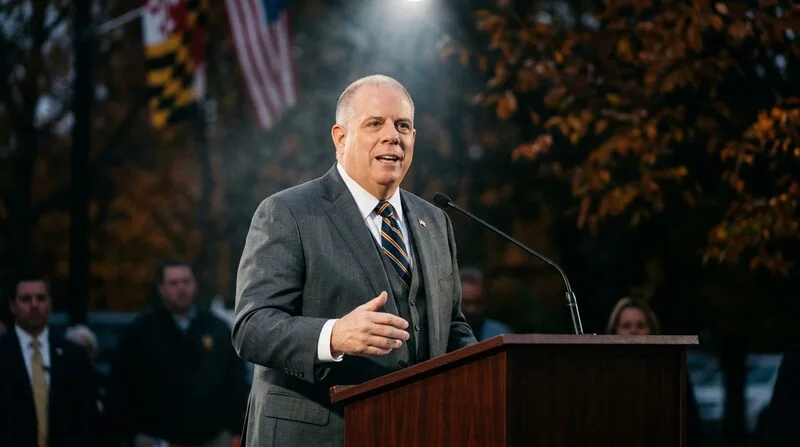
Lawrence J. Hogan Jr. was born on May 25, 1956, in Washington, D.C., and grew up in Prince George's County, Maryland. His father, Lawrence Hogan Sr., served in Congress as a Republican representative from Maryland in the 1970s. Hogan attended the University of Florida and worked in real estate and business before entering politics. He worked in the administration of Maryland Governor Robert Ehrlich (2003-2007) and then ran unsuccessfully for governor in 2014 — or so many expected. He won that race, defeating Democrat Anthony Brown by 4 points in a major upset in a state with a roughly 2-to-1 Democratic base registration advantage.
His governorship became nationally notable for two reasons: his governing effectiveness in a difficult political environment (he maintained approval ratings above 70% for much of his tenure, extraordinary for a Republican in deep-blue Maryland) and his increasingly prominent position as an anti-Trump voice within the Republican Party. He declined to vote for Trump in 2016 and 2020, publicly criticized Trump's handling of the COVID-19 pandemic, the January 6 Capitol attack, and his overall conduct in office. He considered running for president in 2024 but declined, later running for the Maryland Senate majority instead.
He won re-election in 2018 by 12.4 percentage points, a remarkable result for a Republican in Maryland. He was term-limited after two terms and left office in January 2023. His Senate campaign in 2024 was seen as a test of whether his brand of anti-Trump Republicanism could win in a blue state at the Senate level — it could not. He lost to Angela Alsobrooks by approximately 11 points.
- Larry Hogan (R-MD) lost Maryland's 2024 Senate race to Democrat Angela Alsobrooks by 13 points — a surprising result for a two-term Republican governor who had won re-election by 12 points in one of the most Democratic states.
- Maryland is D+25 — one of the most Democratic states, and Hogan's ability to win two gubernatorial elections there made him a national model for moderate Republicanism, but Senate voters proved far less willing to split their tickets.
- He served as Governor of Maryland from 2015-2023 — governing as a fiscal conservative but opposing Trump's immigration policies, mask mandate rollbacks, and the January 6th attack, positioning himself as the most prominent anti-Trump Republican governor.
- His 2024 Senate loss reinforced a key lesson: crossover appeal in gubernatorial races doesn't automatically transfer to Senate races — voters who split tickets for governors are less willing to do so for senators who caucus with the party.

Key Policy Positions
Anti-Trump Republicanism
Hogan became one of the most prominent Republican voices criticizing Donald Trump while still serving in office, a position that required considerable political courage in a party that punishes dissent. He refused to vote for Trump in 2016 (writing in his father) and in 2020, publicly criticized the January 6 Capitol attack as an attempted coup, and supported the bipartisan January 6 Commission. He was mentioned as a potential 2024 presidential candidate before deciding to run for Senate instead.
Bipartisan Governance
Governing Maryland with a heavily Democratic legislature required Hogan to negotiate and compromise. He balanced budgets, maintained the state's AAA bond rating, and avoided shutdowns through pragmatic dealmaking. He worked with Democratic lawmakers on criminal justice reform, education funding (including a $4 billion education reform package known as the Blueprint for Maryland's Future, passed over his veto but reflecting negotiated elements), and infrastructure investment. His approval ratings regularly topped 70%, suggesting genuine cross-party appeal.
COVID-19 Response
Hogan chaired the National Governors Association during the early COVID-19 pandemic and was among the more proactive Republican governors on public health response. He famously arranged a private purchase of 500,000 COVID test kits from South Korea in 2020 — without federal government coordination — when Maryland faced critical shortages, a move that drew national attention and reflected both his initiative and his frustration with the federal response under the Trump administration.
Electoral History
2026/2028 Outlook
Hogan holds no elected office after his 2024 Senate loss and his term-limited gubernatorial exit. His political future depends substantially on the direction of the Republican Party post-Trump. He remains a recognizable figure and one of the few Republicans with a demonstrated record of winning in a blue state (as governor, though not as Senate candidate). If the Republican Party moves toward a more moderate profile in 2028, Hogan is among the figures who could credibly claim to represent that direction.
However, his 2024 loss — in a race many Republicans believed was his best possible vehicle for a Senate majority — raises questions about whether his brand translates outside the executive context. Gubernatorial races allow for more personal brand-building; Senate races are more partisan. His continued media commentary and advocacy on Republican moderation keep him in the conversation, but a return to elected office would require a credible path that is not currently obvious.
Frequently Asked Questions
Who is Larry Hogan?
Larry Hogan is the former Republican Governor of Maryland (2015-2023), known for two landslide gubernatorial victories in a heavily Democratic state and for his prominent anti-Trump positioning within the Republican Party. He lost a 2024 Senate bid to Democrat Angela Alsobrooks.
Why did Larry Hogan lose the 2024 Senate race?
Hogan lost by about 11 points to Angela Alsobrooks. Maryland's 2-to-1 Democratic registration advantage, a polarized national environment, and Trump-driven Democratic base proved too much to overcome at the Senate level, even for a Republican with strong crossover appeal in gubernatorial races.
Did Larry Hogan vote for Trump?
No. Hogan declined to vote for Trump in both 2016 and 2020, writing in his late father Lawrence Hogan Sr. in 2016. He publicly called the January 6 Capitol attack an attempted coup and supported bipartisan investigation of it. His anti-Trump stance is one of the most consistent and public of any Republican officeholder.