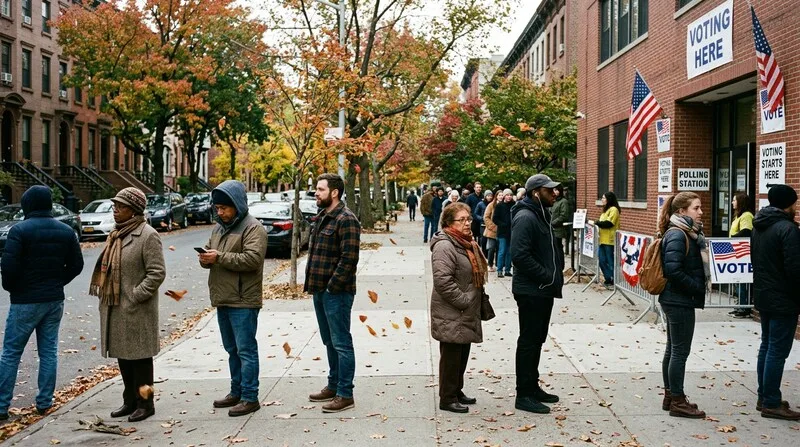
Turnout determines elections as much as persuasion does. The 2018 midterm set a 50-year record at 49.3%. The conditions for 2026 — second-term opposition energy, mail voting infrastructure, Gen Z growth — could match or exceed it.
- 2018 set a 50-year midterm record at 49.3%; 2026 models project 47-52% with a central estimate of 49%, driven by second-term opposition energy and mail voting expansion
- 2014 was the modern midterm low at 36.7% — the 12.6-point gap between low and high turnout cycles represents tens of millions of additional votes and dozens of House seats
- Colorado, Oregon, and Washington's automatic mail-ballot programs produce turnout 10-15 points above the national average — a structural model other states are slowly adopting
- 100M+ Americans voted early or by mail in 2024, raising the structural turnout floor for every future election cycle regardless of enthusiasm levels
Midterm Turnout History: 1970–2022
| Year | Turnout (VEP) | Approx. Votes Cast | Environment | House Seat Change |
|---|---|---|---|---|
| 2018 | 49.3% | 118M | Anti-Trump wave | D +40 |
| 2022 | 46.8% | 114M | Slight R env. / Dobbs D recovery | R +9 |
| 2014 | 36.7% | 83M | Anti-Obama low enthusiasm | R +13 |
| 2010 | 41.8% | 93M | Tea Party wave | R +63 |
| 2006 | 40.4% | 87M | Anti-Bush Iraq wave | D +31 |
| 2002 | 39.5% | 80M | Post-9/11 R boost | R +8 |

What Drives 2026 Turnout Up
Three structural factors push 2026 turnout above the midterm baseline. First, Democratic base enthusiasm in opposition to Trump’s second term mirrors 2018 conditions. Early indicators — special election overperformance, record small-dollar donations, grassroots volunteer sign-ups — all suggest elevated Democratic motivation. This is the single biggest driver.
Second, the expansion of mail and early voting infrastructure since 2020 means the structural floor for participation is higher. States that added permanent mail voting options between 2020 and 2024 saw turnout increases averaging 4–6 points. These structural changes do not disappear between elections. Third, Gen Z voters (now 18–27 in 2026) are adding roughly 3–4 million new eligible voters per election cycle, and this cohort has shown higher midterm participation rates than prior generations at the same age.
State-Level Variation: Where Turnout Matters Most
National turnout averages mask enormous state variation. Colorado, Oregon, and Washington consistently achieve 65%+ midterm turnout due to all-mail voting systems. Mississippi, Oklahoma, and Texas traditionally register 35–42%. The competitive states in 2026 — Wisconsin, Georgia, Pennsylvania, Arizona — all have early voting infrastructure but not universal mail ballot programs.
In Wisconsin, the 2022 turnout was 58.7% — the third highest in the country. High turnout in WI slightly favors Democrats because it brings in sporadic voters who tend to lean Democratic. In Georgia, the 2020 runoff surge demonstrated that Black voter mobilization can close the gap significantly when there is a specific target to organize around.
The Turnout-Outcome Relationship
Higher turnout generally favors Democrats in competitive states, but the relationship is more nuanced than the conventional wisdom suggests. In 2022, high Republican turnout in Florida and Ohio flipped the expected pattern. Turnout alone does not determine outcomes; the composition of who turns out matters more than the raw number.
For 2026, the relevant question is whether the surge in turnout comes from Democratic-leaning demographics (young voters, suburban women, college-educated independents) or Republican-leaning ones (rural voters, non-college white men). Every model for 2026 assumes the former, based on enthusiasm data collected through March 2026.