- 46% of 2022 votes cast before Election Day — roughly double the 2016 baseline of 23%; 8 states now conduct nearly all voting by mail (CA, WA, CO, OR, HI, UT, VT, AK)
- "Red mirage / blue shift": states counting mail last (PA, WI) show large R leads that shrink; states counting mail first (AZ, NV) show early D leads that narrow — creates Election Night confusion
- Republican mail ballot participation partially recovered by 2024 — FL, GA, AZ showed narrower partisan gaps than 2020 after party "bank your vote" programs; gap hasn't fully closed
- Mail ballot rejection rates: 0.4% to 1.8% by state (depends on cure processes); affects D-leaning voters slightly more due to their higher mail ballot usage rates
The Transformed Voting Landscape
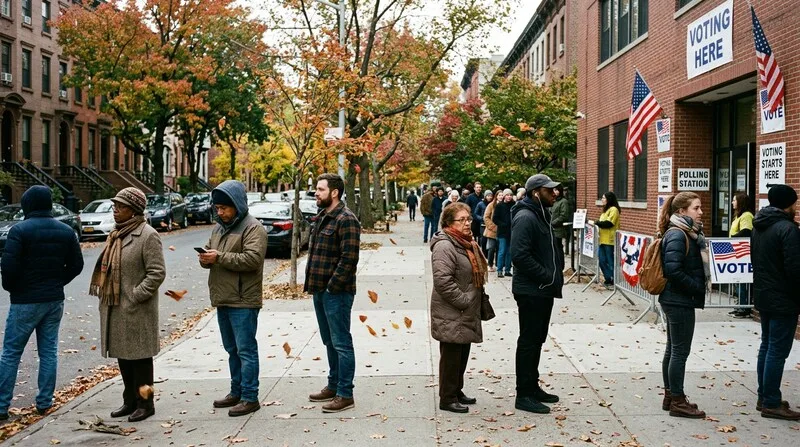
The 2020 pandemic-era expansion of mail and early voting permanently altered the American electoral landscape. What had been a convenience option for a minority of voters became the primary voting method for tens of millions in 2020, and despite significant contraction from those emergency highs, early and mail voting has settled at a new, elevated baseline. In 2022, approximately 46% of all ballots were cast before Election Day — either through in-person early voting at designated locations or through mail ballots returned before or on Election Day. This represents roughly double the pre-pandemic share, and there is no evidence of a return to the 2016 baseline of 23%.
The political calculus around early voting has shifted significantly since 2020. Donald Trump's sustained attacks on mail ballot security during and after the 2020 election created a sharp partisan divergence: Democratic voters embraced mail ballots enthusiastically, while many Republican voters — particularly Trump supporters — were discouraged from using the mechanism. In some competitive 2022 races, Democratic mail ballot advantages of 3-to-1 or greater were significant strategic assets. Republican strategists recognized the problem and invested in "bank your vote" programs encouraging GOP voters to use early voting options in 2022 and 2024.
By 2024, Republican mail ballot participation had recovered somewhat, particularly in states where party leadership actively promoted it: Florida, Georgia, and Arizona all showed narrower partisan gaps in mail ballot requests compared to 2020. The Florida Republican Party's institutional embrace of mail voting — a legacy of senior-heavy demographics that have always preferred absentee ballots — made it a model for Republican early vote programs elsewhere. Still, the gap has not fully closed, and in states like Pennsylvania and Wisconsin where Republicans still lag in mail ballot applications, the counting timeline creates the "red mirage" phenomenon where GOP leads shrink or reverse as mail votes are processed after Election Day.
For 2026, both parties are making strategic investments in early vote programs. Democrats, through the DCCC and state party organizations, are running sophisticated vote-by-mail programs targeting low-propensity Democratic-leaning voters in swing districts — attempting to bank votes before Election Day volatility can affect turnout. Republicans are pushing "souls to the polls" counter-narratives, arguing that Election Day voting produces higher enthusiasm and less ballot rejection risk. The actual data on mail ballot rejection rates is nuanced: rejected ballots in 2022 ranged from 0.4% in states with robust cure processes to 1.8% in states with strict signature match requirements, affecting Democratic-leaning voters slightly more often due to their higher mail ballot usage rates.
Early Voting Rules & 2022 Usage by Key State
| State | Mail Voting Access | 2022 Early/Mail % | Mail D:R Split | Counting Rule |
|---|---|---|---|---|
| Pennsylvania | No-excuse (2019) | 44% | 3.2:1 D | Cannot count until Election Day 7 AM |
| Arizona | No-excuse / PEVL | 79% | 1.5:1 D | Pre-processing allowed; counted Election Night |
| Nevada | Universal mail | 82% | 1.8:1 D | Accept until 7 days post-election if postmarked |
| Wisconsin | No-excuse | 37% | 2.8:1 D | No pre-processing; counted after polls close |
| Georgia | No-excuse | 57% | 1.4:1 D | 3-week early voting; processing pre-Election Day |
| Florida | No-excuse | 64% | 1.1:1 D | Quick count; results often final by 8 PM ET |
| Michigan | No-excuse (2022) | 46% | 2.1:1 D | Pre-processing 10 days out; partial Election Night |

Election Night 2026: The Counting Timeline
The most significant consequence of the early voting landscape for 2026 is the Election Night reporting dynamic. States that prohibit pre-processing or early counting of mail ballots — Pennsylvania and Wisconsin most notably — will show misleading initial results where Republican leads based on Election Day in-person votes shrink or reverse as Democratic-heavy mail ballots are counted in the days following the election. This "blue shift" is a structural feature of state law, not evidence of fraud, but it creates political communication challenges and has historically fueled conspiracy theories about late-counted ballots changing outcomes.
In contrast, states with efficient pre-processing systems — Arizona, Florida, Georgia, and Colorado — can often report more complete, accurate pictures on Election Night itself. Arizona and Nevada, despite accounting for mail ballots after Election Day, have developed reporting infrastructure that provides more informative early tallies. For 2026, analysts and media organizations will need to communicate clearly about which states' early results are reliable indicators versus which results will shift significantly as counting continues. Competitive races in Pennsylvania and Wisconsin may not be called on Election Night even when the underlying outcome is not particularly close, creating days-long uncertainty that both campaigns will attempt to manage narratively.
What This Means for 2026
The early voting landscape provides Democrats with a structural mobilization advantage through the ability to "bank" votes before Election Day, contact and chase returned ballots, and reduce the impact of Election Day weather or last-minute news events. Republicans have partially neutralized this advantage through investment in early vote programs, particularly in Florida and Georgia. The most contested terrain in 2026 is Pennsylvania, where the combination of a no-excuse mail ballot system, a prohibition on pre-processing, and multiple competitive House races creates both maximum uncertainty about Election Night results and maximum stakes for which party wins the early vote banking battle in the weeks before November. States reforming their counting laws — Michigan's pre-processing authorization being the most recent — are gradually reducing the gap between early and final results.