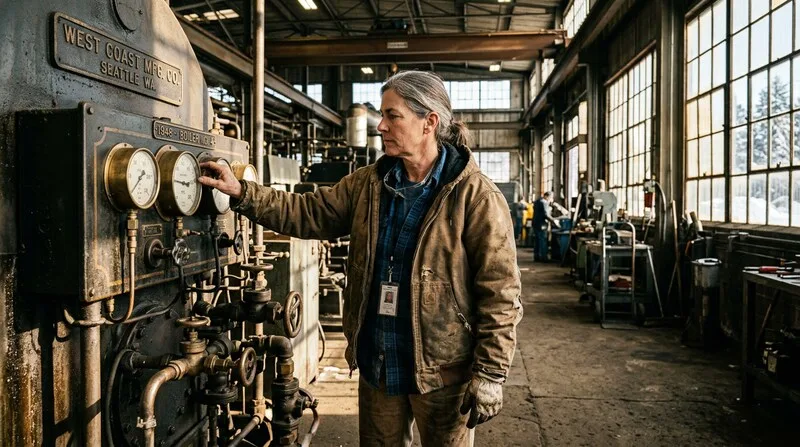
- Manufacturing workers shifted sharply to Republicans 2012-2024; Trump's tariff and trade messaging resonated most in deindustrialized communities that had experienced factory closures under NAFTA and China normalization.
- The input cost problem cuts both ways: tariffs on steel, aluminum, and imported components help some domestic producers while raising costs for auto, appliance, and equipment manufacturers — generating intra-sector conflict.
- Non-college blue-collar manufacturing workers are now Republican-leaning by ~15-20 points; college-educated manufacturing management and engineers remain more competitive.
- 2026 Rust Belt calculus: auto tariffs + DOGE cuts + inflation create crosscurrents in the exact communities where Republicans made their biggest 2024 gains — the same workers who backed tariffs are now experiencing their downstream costs.
The Manufacturing Worker Political Shift
The R+15 margin among manufacturing workers in 2024 represents a political realignment that has been building for 30 years. The decline of industrial unions — from 35% of manufacturing workers in 1980 to under 10% today — removed the primary institutional connection between manufacturing workers and the Democratic Party. As union membership collapsed, the cultural, racial, and geographic identity of manufacturing communities increasingly aligned with Republican populist messaging on trade, immigration, and cultural conservatism.
The promise of tariff protection has been the key policy link between Republican electoral messaging and manufacturing communities' economic interests. The argument — that Chinese imports destroyed manufacturing jobs and tariffs can bring them back — has rhetorical power because it provides a simple explanation for a genuine multi-decade economic loss and a seemingly actionable remedy. The actual causation of manufacturing job loss (primarily automation, with trade a secondary factor) is less emotionally satisfying than the trade explanation.
But the tariff narrative requires that tariffs actually produce the promised jobs, and the Q1 2026 data is testing that promise for the first time under the new tariff regime. The 28,000 net new manufacturing jobs in Q1 2026 is far below the pace of job creation needed to represent a genuine manufacturing revival. It also conceals a significant distributional story: some tariff-protected industries (steel, aluminum, certain domestic manufacturers) have added workers, while others have lost them due to the higher input costs tariffs impose on any manufacturer that uses imported materials.
The Input Cost Problem
The fundamental tension in tariff impact for manufacturing is that protecting one segment of manufacturers inevitably harms another. Tariffs on imported steel protect domestic steel mills — but raise costs for the much larger number of US manufacturers that use steel as an input: auto parts makers, appliance manufacturers, construction equipment producers, food processing equipment manufacturers. Every dollar in added cost for these downstream manufacturers either reduces their competitiveness, reduces their employment, or both.
"Tariffs protect steel mills but hurt steel users. The number of manufacturers that use steel as an input outnumbers domestic steel mills by 80 to 1. For every job protected at a steel mill, 2-3 are at risk at manufacturers downstream. The net is negative. The political story — 'tariffs save manufacturing jobs' — is only true for a fraction of the manufacturing economy."
BLS Q1 2026 Manufacturing Employment | Economic Policy Institute analysis
The primary cause of US manufacturing job loss since 1980 is automation, not trade. US manufacturing output has increased 80% since 1980 — but employment fell because robots replaced workers. Tariffs can shift which country's robots make products for the US market, but they cannot restore the labor-intensive manufacturing that has been automated away. The jobs that tariffs can protect are the jobs automation has not yet reached.
Retaliatory tariffs from China, Canada, Mexico, and the EU have hit US manufacturers who depend on export markets. Soybean farmers, bourbon distillers, Harley-Davidson, and industrial machinery exporters have lost market access. The Midwest manufacturers who benefit from tariff protection on domestic sales are the same communities that lose from retaliatory tariffs on their export sales — a tension that shows up directly in community economic data.
Despite the disappointing job creation numbers, manufacturing workers remain R+15 in April 2026 polling. Political loyalty shifts more slowly than economic satisfaction. The 51% who say the economy is getting worse is a warning sign for Republicans, but it takes time for economy as an issue to translate into political realignment — especially when the alternative party is not currently seen as having a compelling manufacturing jobs message either.

The 2026 Rust Belt Political Calculus
The Rust Belt states — Michigan, Pennsylvania, Wisconsin, Ohio — are the terrain where the manufacturing jobs narrative has the greatest political significance and the greatest distance between promise and reality. Michigan's auto industry faces the sharpest contradiction: tariff protection on domestic vehicles competes with tariff-induced cost increases on the imported components that Michigan's auto parts makers supply to assembly plants across the country.
Democrats have an opening in 2026 to challenge the tariff-equals-manufacturing-jobs narrative with actual data, but it requires a positive alternative. Simply pointing to negative job numbers without offering a competing vision for industrial policy is insufficient — manufacturing communities have voted Republican partly because Democrats abandoned the field on trade and industrial policy in the 1990s and 2000s. The political window to offer a credible alternative is open, but only for candidates who can speak fluently about specific manufacturing sectors, specific trade relationships, and specific investment proposals.
Frequently Asked Questions
How did manufacturing workers vote in 2024?
R+15 — the largest Republican advantage among manufacturing workers since the Reagan era. The shift reflects the decline of industrial unions (from 35% to under 10% of manufacturing workers) and the alignment of working-class cultural identity with Republican populist messaging. Union manufacturing workers still voted Democratic, but non-union manufacturing workers shifted heavily Republican.
How many manufacturing jobs have tariffs actually created?
Net Q1 2026: 28,000. But 180,000 jobs were lost in tariff-disrupted industries that use imported inputs. Steel and appliance sectors gained; auto assembly, electronics, and food processing lost. The net figure conceals a significant distribution story — some communities gained jobs while others lost them due to the same tariff regime.
What do manufacturing workers think about the economy in 2026?
51% say the economy is getting worse (up from 34% in November 2024). 44% say tariffs have hurt their industry more than helped. Manufacturing workers remain R+15 — political loyalty shifts slower than economic satisfaction — but the gap between tariff protection promises and lived economic experience is widening in communities that were central to the 2024 Republican coalition.