
- Trump's exact words (May 1, Forum Club, West Palm Beach): "The USS Abraham Lincoln aircraft carrier will have that come in. Stop about 100 yards offshore, and they'll say, 'Thank you very much. We give up.'" — said the same day he signed a new Cuba sanctions executive order
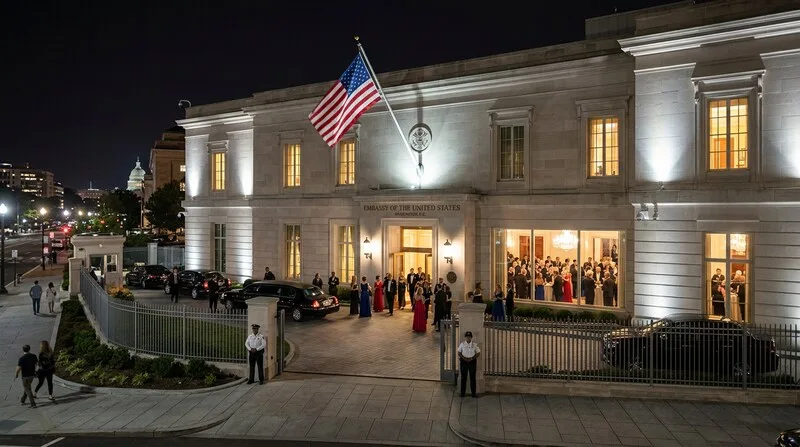
- Raúl Castro, 94, Cuba's former president and First Secretary, made a rare public appearance at the Havana rally — staged directly in front of the U.S. Embassy on the Malecón, under the slogan "La Patria se Defiende"
- The blockade context: The NYT called Trump's 2026 oil tanker restrictions "the first effective blockade of Cuba since the Cuban Missile Crisis" of 1962 — Russia responded by sending oil tankers, directly defying U.S. pressure
- Analysts warn: U.S. military pressure has historically strengthened the Cuban regime (see: Bay of Pigs, 1961) — Bloomberg Opinion: "Is Cuba the Next Donald Trump Military Misadventure?"
The Statement That Set Off Alarm Bells
On the evening of May 1, 2026, at a private dinner for donors at the Forum Club of the Palm Beaches in West Palm Beach, Florida, President Trump made a series of remarks about Cuba that immediately ricocheted around the world. He was speaking on the same day his administration signed a new executive order dramatically expanding sanctions against Cuba — and on the same day that an estimated 500,000 Cubans gathered on the Havana waterfront in a government-organized show of defiance against Washington.
Trump's words were delivered with characteristic performance: "Now Cuba's got problems. We'll finish one first. I like to finish a job. On the way back from what we'll do... on the way back from Iran, we'll have one of our big, maybe the USS Abraham Lincoln aircraft carrier — the biggest in the world — will have that come in. Stop about 100 yards offshore, and they'll say, 'Thank you very much. We give up.'" He added: "He comes from a place called Cuba, which we will be taking over almost immediately."
Whether the remarks were policy or performance is a distinction Washington's allies and adversaries do not afford themselves the luxury of making. The Cuban government treated them as a threat. Russia condemned them as "gross interference." China called the broader regional pattern an "extremely dangerous precedent." And Díaz-Canel, Cuba's president, had already said in a prior NBC interview: "If we need to die, we'll die."
The Havana Rally: What Actually Happened
The May Day march in Havana was not, as Trump's framing implied, a popular uprising demanding regime change. It was the opposite. The Cuban government organized the demonstration as a direct counter to Trump's escalating pressure campaign, deliberately relocating the traditional march from Revolution Square to the Malecón waterfront — facing the U.S. Embassy. The slogan "La Patria se Defiende" (The Homeland is Defended) left no ambiguity about its message.
The most significant element was the appearance of Raúl Castro, 94 years old, Cuba's former President and former First Secretary of the Communist Party (he governed 2008–2021). Castro rarely appears in public anymore; his presence alongside current President Díaz-Canel was a deliberate signal of regime continuity and unity — the old guard and the new, together, facing Washington. The regime's 500,000 attendance claim cannot be independently verified, and opposition sources reported lower-than-typical turnout with evidence of state pressure on workers and students to attend.
But there is a parallel Cuba running simultaneously. Since early 2026, the country has experienced a genuine grassroots protest movement — not pro-government but anti-government. The Cuban Observatory of Conflicts documented over 11,000 protests, complaints, and public expressions of dissent in 2025 alone. In March 2026, marchers in the city of Morón stormed and burned the local Communist Party headquarters. The government has arrested hundreds. The May Day spectacle was, in part, the regime's answer to this unrest: a display of organized mass loyalty, framed against an external enemy.
The Escalation Timeline: From Sanctions to Carriers
| Date | Event | Significance |
|---|---|---|
| Jan 2026 | Executive Order 14380: national emergency, tariffs on countries supplying oil to Cuba | Effectively an oil blockade — first of its kind since 1962 |
| Feb 27, 2026 | Trump suggests “friendly takeover” of Cuba | First explicit regime-change language |
| Mar 6, 2026 | CNN interview: “Cuba is gonna fall pretty soon” | Trump promises “Marco [Rubio] over there” to manage transition |
| Mar 13, 2026 | Morón protest: marchers burn Communist Party HQ | Most radical anti-government action in years; 14+ arrested |
| Mar 28, 2026 | Miami speech: “Sometimes military force must be employed, and Cuba is next” | First explicit military threat in a formal speech |
| April 2026 | Cuba releases 2,000+ political prisoners | Secret U.S.–Cuba diplomatic meetings confirmed by Díaz-Canel |
| Apr 28, 2026 | Trump declares naval blockade of Iran; Brent crude hits $118 | Global oil shock; Hormuz closure; sets stage for Cuba escalation |
| May 1, 2026 | 500,000 rally in Havana + Trump's carrier statement + new sanctions EO | Crisis reaches peak public intensity |
What Moscow and Beijing Calculate
Russia's response to Trump's Cuba pressure has been both verbal and material. Moscow condemned the carrier statement as “gross interference in the internal affairs of a sovereign state, intimidation, and the use of illegal unilateral restrictive measures.” More significantly, Russia sent at least two oil tankers to Cuba in March and April 2026, directly defying U.S. blockade pressure in a replay of Cold War-era geopolitics. For Putin, Cuba is not primarily about Cuba — it is a demonstration that Russia remains capable of projecting influence in the Western Hemisphere despite the Ukraine war and Western sanctions.
China's calculation is more cautious but equally pointed. Beijing condemned the broader regional pattern — including Trump's Venezuela operation — as setting an “extremely dangerous precedent.” China has significant economic interests in Cuba, including tourism infrastructure and a reported intelligence-collection facility near Havana. A destabilized or U.S.-dominated Cuba would eliminate a strategically positioned outpost 90 miles from Florida. Chinese officials are watching the carrier threat carefully: it is, in miniature, a test of whether the U.S. will use naval power unilaterally against a country that poses no direct military threat to American territory. That question has obvious implications for Taiwan.
“Is Cuba the Next Donald Trump Military Misadventure?”
— Bloomberg Opinion, April 19, 2026
History as Warning: The Bay of Pigs Lesson
Every analyst examining Trump's Cuba escalation has invoked the same historical benchmark: the Bay of Pigs, April 17–20, 1961. CIA-organized Cuban exile forces, trained and equipped by the U.S., landed at the Bahía de Cochinos expecting popular support and swift regime collapse. They were defeated in 72 hours. More importantly, the invasion produced the exact opposite of its intended effect: Castro declared Cuba a socialist state mid-invasion, sought Soviet military protection, and that Soviet protection led directly to the deployment of nuclear missiles on the island — and the Cuban Missile Crisis of October 1962, the closest the Cold War came to nuclear exchange.
The structural lesson from 1961 remains relevant in 2026: external military pressure on the Cuban regime has historically consolidated it rather than collapsed it. The government uses U.S. threats as the primary justification for its extraordinary repression of civil society. An aircraft carrier off Havana would be the most powerful recruitment tool the Cuban government has seen since the Bay of Pigs. Whether the Trump administration understands this dynamic — or believes this cycle can be broken by sufficient force — remains the central question of U.S. Cuba policy.
The Polling: Americans Are Not With Trump on Cuba
The public opinion picture is unusually clear for a foreign policy question: Americans broadly oppose military intervention in Cuba. The 71% Republican support figure is high but represents a partisan base that historically endorses hawkish Cuba positions; the 23% overall support for military force means Trump's carrier threat — even framed rhetorically — has limited public mandate. As seen with the Trump approval trajectory, foreign policy overreach that raises oil prices and military risk registers negatively with independent voters. The economy-Cuba connection runs through the Strait of Hormuz and global oil markets; any Cuban military operation that further elevated energy prices would compound the economic pressures already driven by tariffs.


