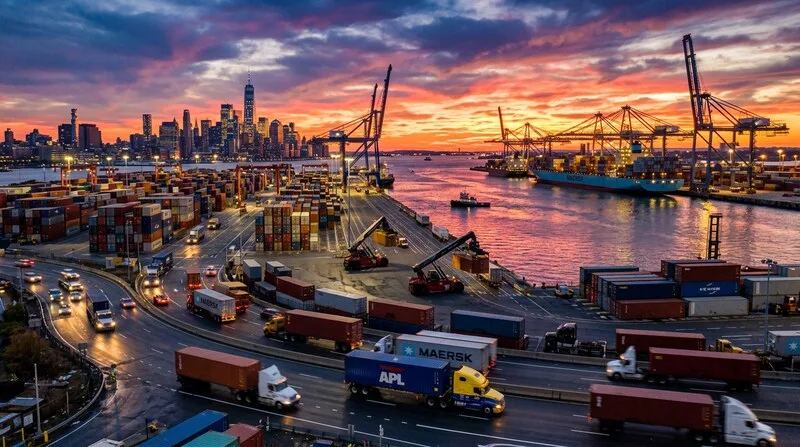
- USDA estimates net farm income fell ~12% in 2025 vs. 2024 — reversing the strong farm income years of 2021-2023, driven primarily by retaliatory tariffs reducing export demand
- China's 25% retaliatory tariff on US soybeans and pork is targeted at the crops that dominate Iowa, Illinois, Minnesota, Nebraska, and South Dakota — all states that voted heavily for Trump
- China was the #1 buyer of US soybeans before the trade war — its retaliatory tariff wall has redirected US agricultural exports to lower-value markets at a significant price discount
- The Trump administration discussed a new farm aid package similar to the $28B Market Facilitation Program used in 2018-2019, signaling recognition that the political cost in farm states is real
- The tariff retaliation map overlaps almost perfectly with the Republican electoral map — creating a political bind where the administration's trade policy is harming its most reliable constituencies
Farm State Exposure: Key Commodity States
The tariff retaliation map overlaps almost perfectly with the Republican electoral map. These are states that have delivered large Trump margins while simultaneously being most exposed to the consequences of his trade policy. Farm groups are lobbying for exemptions or a new round of aid payments.
| State | Top Affected Commodities | Retaliating Country | Est. Annual Farm Loss | 2024 Pres. |
|---|---|---|---|---|
| Iowa | Soybeans, corn, pork | China (soybeans 25%, pork 25%) | ~$2.1B | R+12 |
| Illinois | Soybeans, corn | China (soybean retaliation) | ~$3.2B | D+12 |
| Minnesota | Soybeans, corn, dairy | China / Canada | ~$1.6B | D+2 |
| South Dakota | Soybeans, wheat, cattle | China / EU | ~$980M | R+26 |
| Nebraska | Cattle, corn, soybeans | China (beef/corn) | ~$2.0B | R+20 |
| Indiana | Corn, soybeans | China (full commodity retaliation) | ~$1.4B | R+18 |
| Mississippi / Alabama | Cotton | China (cotton retaliation) | ~$1.1B | R+20+ |

Commodity by Commodity: Soybeans, Corn, Cotton
Soybeans
China was the dominant buyer of American soybeans before 2018. Chinese 25% retaliatory tariffs on US soybeans drove a significant shift toward Brazilian soy. Brazil dramatically expanded soybean planting to fill the gap. In 2026, China has not returned to pre-2018 US soybean purchase levels even after partial trade deals. The soybean price is 15-20% below its 2022 peak. Iowa and Illinois are most exposed; both states together produce roughly 25% of the world’s soybean crop.
Corn
Corn faces a dual impact. Export markets — Mexico (which buys 25-30% of US corn exports) and China — have been disrupted by retaliatory tariffs. Additionally, the domestic ethanol market depends on corn prices and fuel demand; tariff-driven economic slowdowns reduce fuel consumption. Iowa is the largest corn-producing state and the largest ethanol-producing state. The corn-ethanol-soybean rotation that dominates Midwest farming is under economic stress from multiple directions simultaneously.
Cotton
Cotton is produced primarily in Texas, Mississippi, Alabama, Georgia, and the Carolinas. China is the largest buyer of American raw cotton and has applied retaliatory tariffs. Additionally, 145% tariffs on Chinese-manufactured goods have created disruptions in the global textile supply chain that affect cotton prices. The National Cotton Council reported that 2025 farm income fell for cotton growers in double digits. Unlike soybeans, cotton does not have an easily substituted domestic use; export market loss is more directly felt in farm-gate prices.
The Political Bind: Republican Farmers in a Republican Trade War
The political paradox of the farm tariff impact is that the states most economically harmed are among the most electorally loyal to Trump and the Republican Party. Iowa, Nebraska, South Dakota, and Kansas voted for Trump by double-digit margins in 2024. Farm groups and agricultural lobbies have expressed concern through official channels while maintaining that partisan loyalty is not contingent on short-term trade policy outcomes.
The 2026 electoral calculus is nuanced. Iowa does not have a competitive Senate race in 2026; Senator Chuck Grassley (R), if he runs, faces no competitive challenge despite his age. Nebraska’s Senate seat is safely Republican. The farm income pressure matters more in swing-state House districts in Illinois, Minnesota, and Wisconsin — states where Democratic incumbents represent rural and exurban districts with significant agricultural economies.
The Trump administration has signaled it is exploring a new round of direct payments to farmers — analogous to the Market Facilitation Program that distributed $28 billion between 2018 and 2020. Farm groups have been divided on whether direct payments are adequate compensation for lost market access, which is more damaging to long-term competitiveness than short-term income support can address. Brazil has made permanent market share gains in China that may not reverse even if US-China tariffs are eventually reduced.
Related Analysis
Tariff Pain by State
Full state-by-state breakdown of tariff economic exposure beyond agriculture.
Tariffs & Voters 2026
How tariff sentiment breaks down by party, region, and voter type.
Iowa Senate 2026
Grassley’s potential final campaign and the farm economy backdrop.