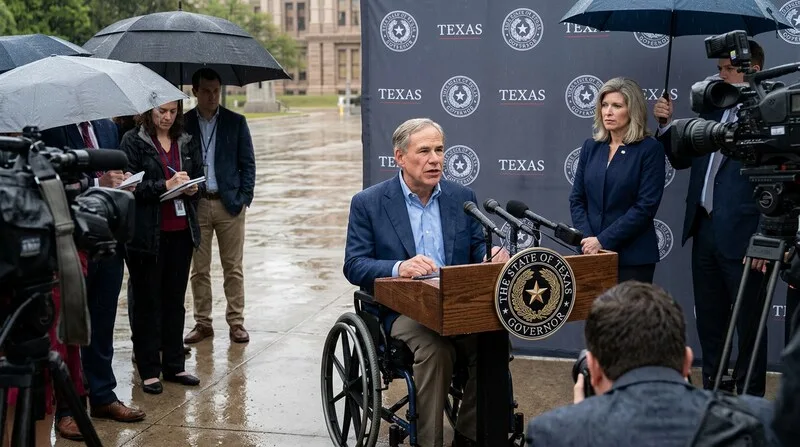
- Greg Abbott (R-TX) won re-election as Texas governor in 2022 by 11 points over Democrat Beto O'Rourke — a decisive win in a state where Republicans have held every statewide office since 1994 and show no signs of losing their structural advantage.
- Texas is R+11 — a solidly Republican state that Democrats have hoped to make competitive for a decade, but Abbott's 11-point win showed the gap has not narrowed despite demographic changes in Austin, Houston, and Dallas suburbs.
- Abbott was paralyzed in 1984 when a tree fell on him during a jog — he sued the property owner and used the settlement to fund his law career, then became a Texas Supreme Court justice and Attorney General before winning the governorship in 2014.
- He has made border security his signature issue — spending billions on Operation Lone Star, busing migrants to blue-state cities, and deploying National Guard troops to the Rio Grande, positioning Texas as the model for Republican border policy.

Biography
Gregory Wayne Abbott was born on November 13, 1957, in Wichita Falls, Texas, and grew up in the Dallas suburb of Duncanville. He earned his undergraduate degree from the University of Texas at Austin and his law degree from Vanderbilt University Law School. His life changed permanently in 1984, when he was jogging near his home in Houston and a large oak tree fell on him, severing his spinal cord and permanently paralyzing him from the waist down. He uses a wheelchair. He won a multi-million dollar lawsuit against the property owners, which provides him an annual settlement, and has faced questions throughout his career about his public support for limits on tort damages while having personally benefited from expansive tort law.
Abbott built his career in Texas law and Republican politics, serving as a Texas Supreme Court justice from 1996 to 2001 and then as Texas Attorney General from 2003 to 2015 — one of the longest-serving attorneys general in Texas history. As AG he filed more than 30 lawsuits against the Obama administration on issues ranging from the Affordable Care Act to immigration to EPA regulations, building a national profile as the most aggressive state-level legal antagonist of the Obama administration. He was elected governor in 2014 to succeed Rick Perry, who did not seek re-election, winning by 20 points. He was re-elected in 2018 by 13 points and in 2022 by 11 points over Democrat Beto O'Rourke.
His governorship has been defined by aggressive border security measures (Operation Lone Star), some of the nation's most restrictive abortion laws, significant economic development success (Texas has attracted major corporate relocations from California and elsewhere), and controversies including the Winter Storm Uri electric grid failure in February 2021, which killed hundreds of Texans and exposed the fragility of the state's independent electric grid. His response to Uri was widely criticized but did not meaningfully damage his political standing with Texas Republicans.
Key Policy Positions
Border Security & Immigration
Abbott's most defining policy as governor has been his aggressive approach to the US–Mexico border. Operation Lone Star deployed state troops and law enforcement at a cost of billions; his "busing" program transported migrants to Democratic cities in the Northeast and Midwest; and he challenged federal immigration authority by attempting to install razor wire and floating buoys in the Rio Grande, leading to Supreme Court litigation over state versus federal control of border enforcement. His border record has made him a national Republican figure on immigration and earned him strong support from Donald Trump and the MAGA base. Critics argue the policies are expensive, performative, and in some cases cruel, while generating little measurable reduction in crossings.
Abortion & Social Policy
Texas under Abbott enacted SB 8 in 2021 — the nation's first effective six-week abortion polling after decades of Roe protections — and after Dobbs implemented a near-total ban with narrow life-of-the-mother exceptions. The restrictions are among the most stringent in the country, and multiple high-profile cases of women being denied abortion care during serious medical complications generated national attention. Abbott has also signed legislation restricting transgender healthcare for minors, limiting drag performances, allowing school vouchers, and restricting DEI programs in universities. Texas has become a model for conservative social policy implementation at the state level.
Economic Development & Energy
Abbott has presided over significant Texas economy polling, including major corporate relocations from California (Tesla, Oracle, HP, Charles Schwab), strong job creation, and semiconductor investment. He has promoted Texas's low-tax, low-regulation business environment as a model for conservative economic governance. On energy, he is a strong supporter of the Texas oil and gas industry while also presiding over significant wind and solar growth (Texas leads the nation in wind energy). His handling of the 2021 Winter Storm Uri electric grid failure — which the state's independent ERCOT grid could not handle, leading to hundreds of deaths — remains a significant black mark on his economic record, though the legislature subsequently passed some grid hardening measures.
Electoral History
| Year | Race | Opponent | Abbott % | Margin | Result |
|---|---|---|---|---|---|
| 2014 | Governor (1st) | Wendy Davis (D) | 59.3% | +20.4 | Won |
| 2018 | Governor (2nd) | Lupe Valdez (D) | 55.8% | +13.3 | Won |
| 2022 | Governor (3rd) | Beto O'Rourke (D) | 54.8% | +11.2 | Won |
| 2026 | Governor (4th) | TBD (D) | TBD | — | Safe R |
Abbott's 11-point win over Beto O'Rourke in 2022 — despite O'Rourke being one of the most prominent and well-funded Democratic challengers in Texas history — confirmed that Texas remains firmly Republican at the statewide level, even as Democrats make incremental gains in suburban areas around Austin, Houston, and Dallas.
2026 Re-Election Outlook
Greg Abbott's 2026 re-election is rated Safe Republican. Texas has not elected a Democrat to statewide office since 1994, and Abbott has won his three gubernatorial elections by comfortable double-digit margins. Even his narrowest race — the 2022 rematch with the highest-profile Democratic challenger he has faced — resulted in an 11-point victory. The Democratic Party has not yet identified a credible 2026 challenger, and the state's structural lean toward Republicans in statewide races shows no sign of changing in a single cycle.
Abbott's long-term political future is the more interesting question. He has no obvious path to higher federal office (both Senate seats are held by Republicans), and his national profile is significant but has not translated into presidential ambition. His legacy will likely be defined by his border security posture, his role in the abortion polling landscape, and whether Texas's economic success continues or is disrupted by climate-related infrastructure challenges or economic headwinds.