- 2018 set a 50-year midterm high at 49.3% — the highest midterm participation since 1914, driven by anti-Trump Democratic mobilization
- 2022 held at 46.4% despite structural Republican advantages, as Dobbs-driven enthusiasm limited GOP gains to a narrow House majority
- 35% of 2022 votes were cast early or by mail, up from 24% in 2018 — a new structural floor that won't return to pre-pandemic levels
- 18+ states tightened voting access since 2020; high-turnout environments consistently benefit Democrats through expanded youth and urban participation
Midterm Turnout in Historical Context
American midterm turnout has historically ranged from a low of about 36% (2014) to the 2018 high of 49.3% — the highest midterm participation since World War I. The pattern is well-established: the party out of the White House typically generates more enthusiasm, its base voters are more motivated to express frustration through the ballot, and the opposing party's voters are complacent after winning the presidency. The magnitude of this asymmetry varies, but its direction has been reliable enough that it functions as a structural assumption in midterm forecasting models.
The 2022 cycle partially broke this pattern. Republicans were expected to ride a historic red wave; instead, they gained only a narrow House majority and lost the Senate net seat count. Democrats managed above-baseline turnout through a combination of sustained anger over the Supreme Court's Dobbs decision overturning Roe v. Wade, DOGE-precursor concerns about Republican intentions toward Medicaid and Social Security, and strong candidate quality in Senate races. The lesson was not that the structural advantage disappeared — it still existed — but that sufficiently high-intensity Democratic mobilization can offset it.
2010 (R wave, -63 D House seats): 40.9% | 2014 (R wave, -13 D House seats): 36.7% | 2018 (D wave, +40 D House seats): 49.3% | 2022 (Muted R wave, +9 R House seats): 46.4%. Every point of turnout matters: the 12.6-point gap between 2014 and 2018 represents tens of millions of additional votes.

The Evolution of Early and Mail Voting
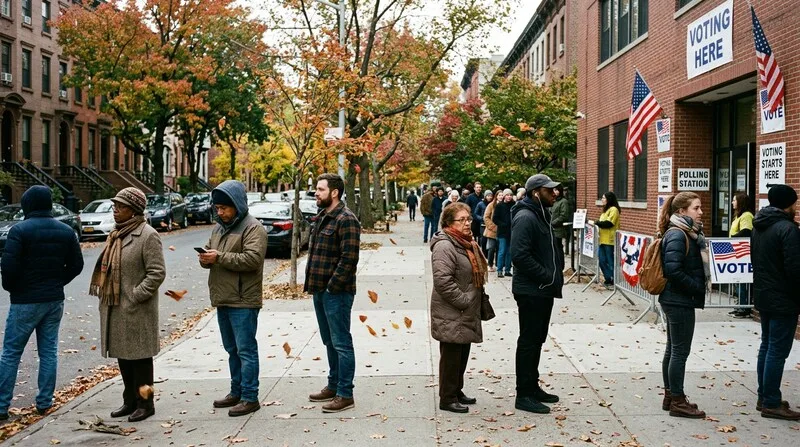
The COVID-19 pandemic permanently changed the American voting infrastructure. In the 2020 general election, approximately 46% of all votes were cast by mail — a number driven by pandemic conditions but also by broad voter discovery that absentee voting was convenient. In the 2022 midterms, that share dropped back to roughly 35% as in-person voting resumed more normally, but the floor did not return to pre-pandemic levels of around 24% in 2018 midterms. A new normal has been established at a higher early/mail share.
This matters because early voting changes campaign strategy. Campaigns can no longer rely on a single Election Day push; they must maintain voter contact throughout the early voting period, which in some states begins six weeks before Election Day. Get-out-the-vote operations have shifted to "vote banking" strategies — banking votes from confirmed supporters as early as possible, so that late campaign developments do not undermine the coalition. Democrats have historically been more efficient at early vote banking in urban areas; Republicans have historically depended more on Election Day turnout. The partisan composition of the early vote is a constant subject of partisan spinning in the days before each election.
Voting Restrictions Since 2020: The State-by-State Picture
In the aftermath of the 2020 election, Republican-controlled state legislatures in more than 18 states passed legislation tightening voting access. The measures varied: some shortened early voting periods, others added ID requirements for absentee ballots, others restricted mail ballot drop boxes, and a few eliminated no-excuse absentee voting. The explicit justification was election integrity; critics argued the measures were designed to reduce turnout among Democratic-leaning constituencies including young voters, urban voters, and minority voters who disproportionately rely on early and mail voting.
Georgia's Senate Bill 202 (2021) became the most litigated and analyzed example. It restricted ballot drop boxes, required ID for absentee voting, and limited early voting on Sundays — a measure critics connected to "Souls to the Polls" church-organized turnout drives. Despite dire predictions of suppressed turnout, Georgia's 2022 midterm participation was high by historical standards. The Senate runoff between Warnock and Walker drew exceptional turnout from both parties. Election researchers continue to debate whether the restrictions depressed some categories of voter participation even as total turnout remained elevated.
Florida enacted Senate Bill 90 in 2021, among the most restrictive new laws, limiting who can collect and return mail ballots, reducing the time absentee ballot applications are valid, and restricting mobile ballot collection. Florida's political geography shifted significantly Republican over the subsequent two election cycles, though isolating the effect of voting law changes from broader political realignment is analytically difficult.
Turnout Scenarios — What Different Models Mean for 2026
| Scenario | Est. Turnout | Key Driver | Projected Senate Outcome |
|---|---|---|---|
| High D enthusiasm (2018-like) | 48-50% | Medicaid/healthcare mobilization | D net +3-4 seats |
| Moderate turnout (2022-like) | 45-47% | Mixed enthusiasm, economy central | R hold +1-2 seats |
| Low D enthusiasm (2014-like) | 38-42% | D base fatigue, low youth turnout | R wave +5-8 seats |
| Early vote share (projected) | ~36-38% of total ballots | Slight increase from 2022 | |
| Youth turnout (18-29) — high scenario | 28% | Student debt, abortion, AI concern | +2-3 pts D in college districts |
| Youth turnout (18-29) — low scenario | 20% | Midterm fatigue, disillusionment | Negligible D youth boost |
Sources: U.S. Elections Project, Catalist voter file analysis, party internal turnout models. Projections as of early 2026; highly dependent on late-cycle events and candidate quality.
The Democratic Enthusiasm Question
The central variable in 2026 turnout models is not Republican enthusiasm — which is relatively stable and well-measured — but Democratic base mobilization. In 2018, Democratic enthusiasm was extraordinary and sustained from the 2017 Women's March through Election Day. In 2022, it surged late, driven by Dobbs, and held up enough to prevent the expected red wave. In 2024, it collapsed in the specific form of Black and young male voter defections that proved decisive in several swing states.
Going into 2026, Democratic strategists are reading enthusiasm tea leaves carefully. Sustained protest activity over DOGE and federal workforce cuts in early 2025 was encouraging. Medicaid polling suggests a mobilizing issue with broad reach into moderate and even some Republican-leaning constituencies. The abortion rights issue remains potent in certain states. But enthusiasm polls in early 2026 show Democratic voters at elevated but not 2018-level motivation, and the structural challenge of a party defining itself primarily through opposition — with no presidential nominee and a divided congressional caucus — remains real.
Voter ID laws and early voting restrictions add genuine uncertainty to turnout models in key states. Georgia, Wisconsin, Arizona, and Nevada all have restriction regimes that were not in place during earlier Democratic wave elections. The magnitude of suppression effects from these laws is genuinely contested among election researchers, with estimates ranging from negligible (0.5-1 point) to significant (2-4 points) in turnout-differential effects. In elections decided by 1-2 points, those ranges are election-determining.
Frequently Asked Questions
What was midterm voter turnout in 2022 and 2018?
2022 midterm turnout was 46.4% — above the historical average (~40%) but below the 2018 wave election record of 49.3%. 2018 was the highest midterm turnout since 1914, driven by anti-Trump Democratic mobilization. Higher turnout historically benefits Democrats; the 2022 number helped limit Republican gains to a narrow House majority.
How widespread is early and mail voting in 2026?
In 2022, roughly 35% of midterm votes were cast early (mail or in-person early voting), up from ~24% in 2018. The COVID pandemic permanently raised the floor for early and mail voting. In 2026, projections estimate 36-38% early vote share. State variation is enormous: Colorado, Washington, and Oregon conduct near-universal mail voting; Florida has tightened absentee rules since 2021.
What do different turnout scenarios mean for 2026?
High turnout (~49%, 2018-like): Democrats net +3-4 Senate seats, driven by healthcare mobilization. Moderate turnout (~46%, 2022-like): Republicans hold +1-2 seats. Low turnout (~40%, 2014-like): Republican wave of +5-8 seats. The critical variable is Democratic base enthusiasm. Current early-2026 polling shows elevated but not 2018-level Democratic motivation — pointing to a competitive cycle rather than a wave in either direction.